Around ten years ago, the term “sandwiched family” was rarely mentioned. However, in recent years, the government has expressed concerns about the growing number of “sandwiched couples having to care for both the young and old”, in light of Singapore’s low birth rates and rapidly ageing population.
Why is Singapore facing an acute problem with sandwiched families today?
This is a combination of a few key factors in our demographic reality.
Rising Ages of First Marriage and Parenthood
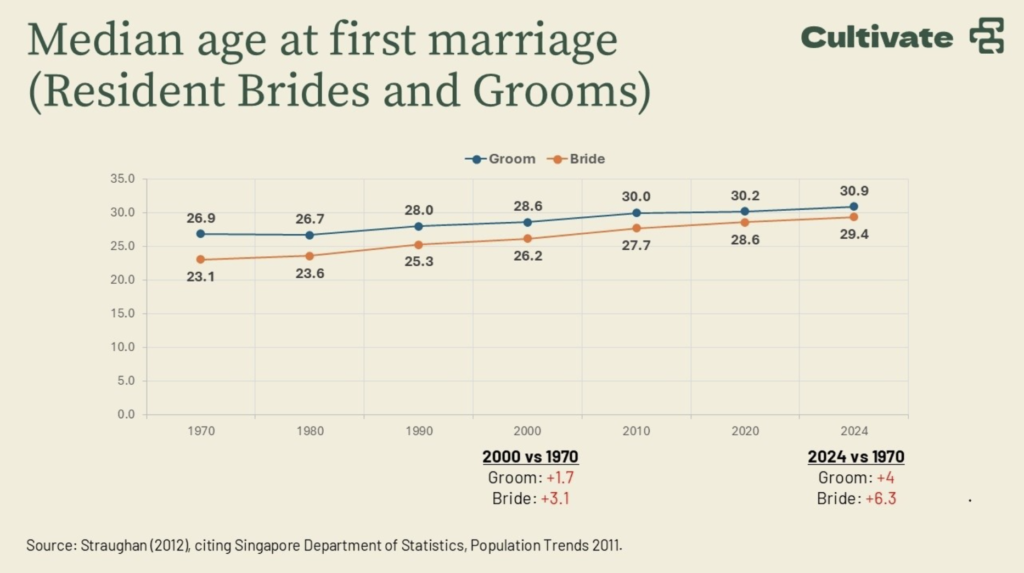
Firstly, the median age at first marriage has been trending upwards. Compared to the 1970s and 1980s when people married in their 20s, Singaporeans today are marrying when they are around 30 years-old.
From 1970 to 2024, there has been an increase of 4 years in the median age at first marriage for grooms, and the figure is even higher for brides (6.3 years increase).
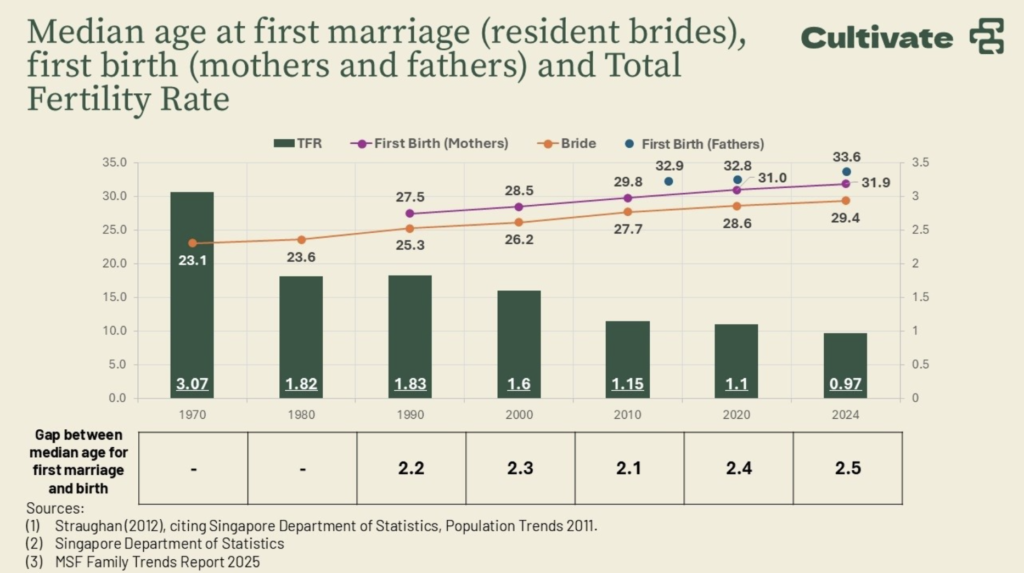
On the other hand, Singaporeans have more than a two-year gap between getting married and having their first child. In 2024, the median age of first birth was 31.9 for mothers and 33.6 for fathers.
(One caveat is that the data reflects national average data, and it does not compare every single person or claim that this is the case for everyone. For instance, a small number of people do have children before they get married.)
Rising Life Expectancy
The second factor is the increase in life expectancy in Singapore over time.
In the 1970s, the overall average life expectancy was only around 65.8 years. Today, life expectancy has increased by nearly 20 years, which is a positive thing.
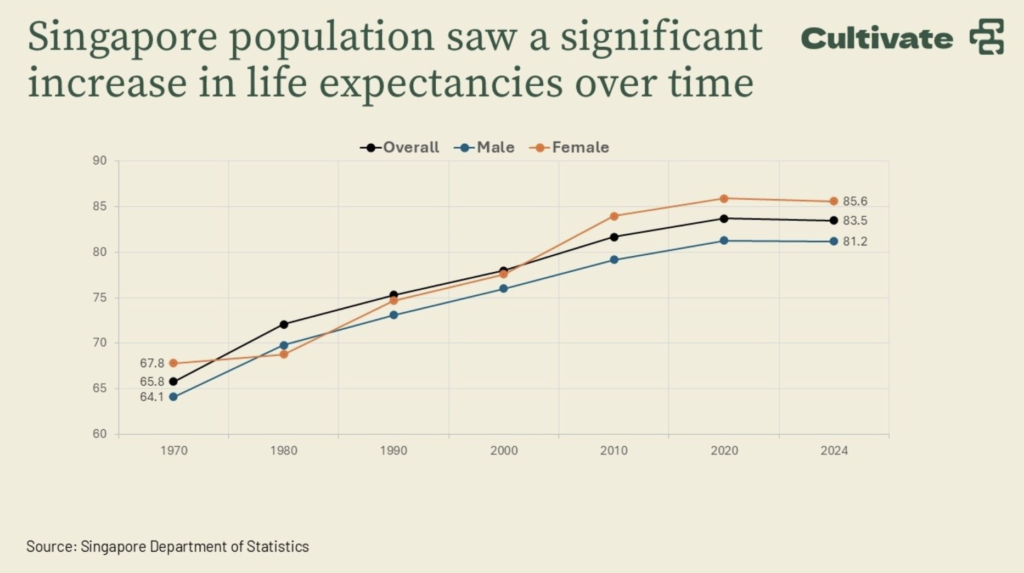
Although life expectancy in Singapore is approximately 84 years, our average health span is around ten years less than that, which means that – in the words of Health Minister Ong Ye Kung – “the average Singaporean suffers ten years of ill health before passing away”.
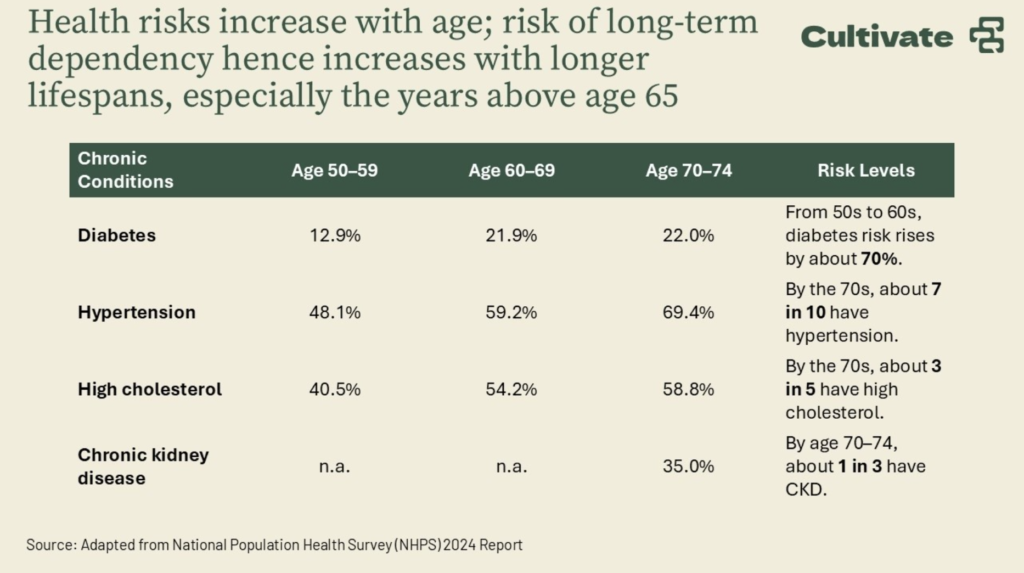
The hard truth and reality of life is that health risks increase with age, and the risk of long-term dependency increases with longer lifespans. The risk of chronic conditions such as diabetes, hypertension, high cholesterol and chronic kidney diseases significantly increases as people age.
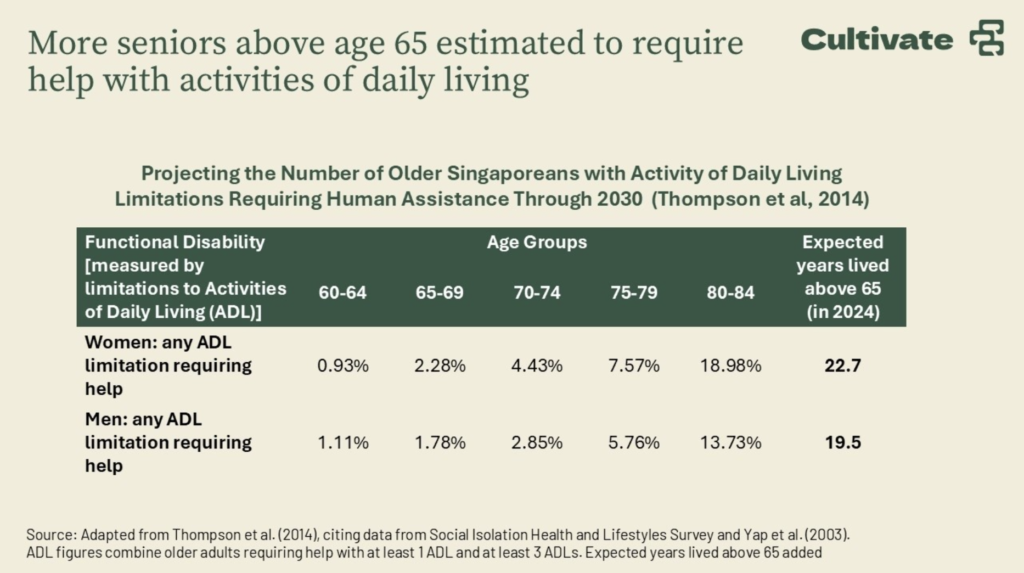
In a May 2025 speech, Minister Ong further predicted a doubling in number of seniors aged 65 and above who will require assistance with at least one activity of daily living:
“The population and proportion of seniors aged 65 and above is rising. It is about around 750,000 now, and will reach about one million in 2030. If half of these seniors have at least one chronic disease – and that is actually a conservative estimate – the number of seniors with chronic diseases will grow from 375,000 now to 500,000 in just five years. It is a 30 percent jump in numbers.
As age catches up, the number of seniors who require assistance with at least one activity of daily living (ADL) is expected to almost double within a decade, from 58,000 in 2020 to 100,000 in 2030. This increase is far more than the estimate for chronic illness. Because not only are we ageing, we also have more and more people in the 70 to 80s bracket, above 80 bracket, even in the centenarian bracket, and they are more likely to be frail.”
These numbers had been predicted roughly a decade earlier, in a 2014 study by Thompson and others. In that study, the authors predicted that the number of resident Singaporeans aged 60 years or older with activity limitations would grow rapidly from 31,738 in 2010 to 82,968 in 2030.
Smaller Family Sizes
The third factor arises from smaller family sizes.
Birth rates have been declining over time. The two-child family is the norm today, though there are some who have fewer or no children and some who have more than two children.
This means that there would be fewer family members who can help to share the load of elder caregiving when the seniors require care.
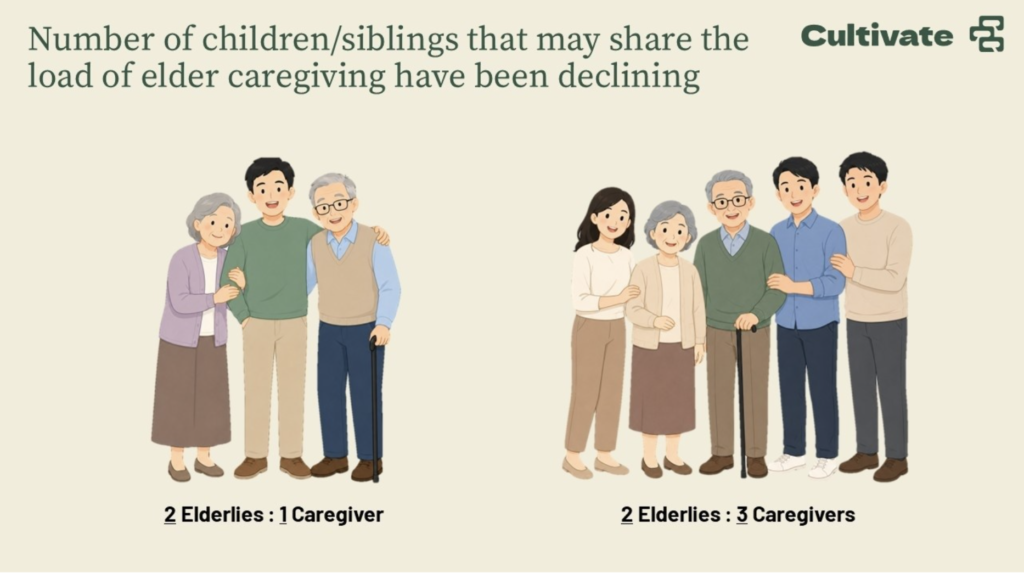
Illustration: Three Cases of a 33-year-old Father in 2026
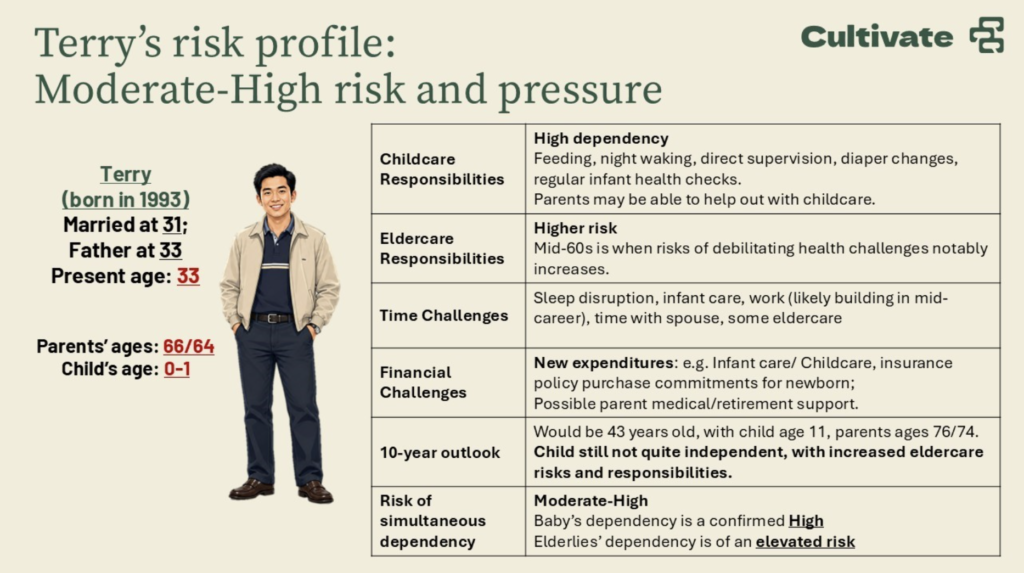
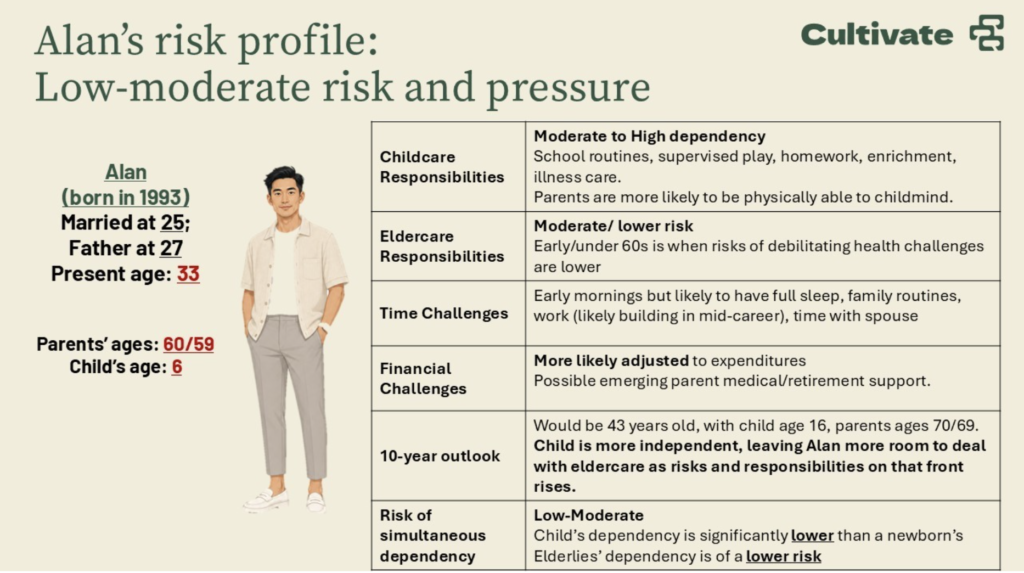
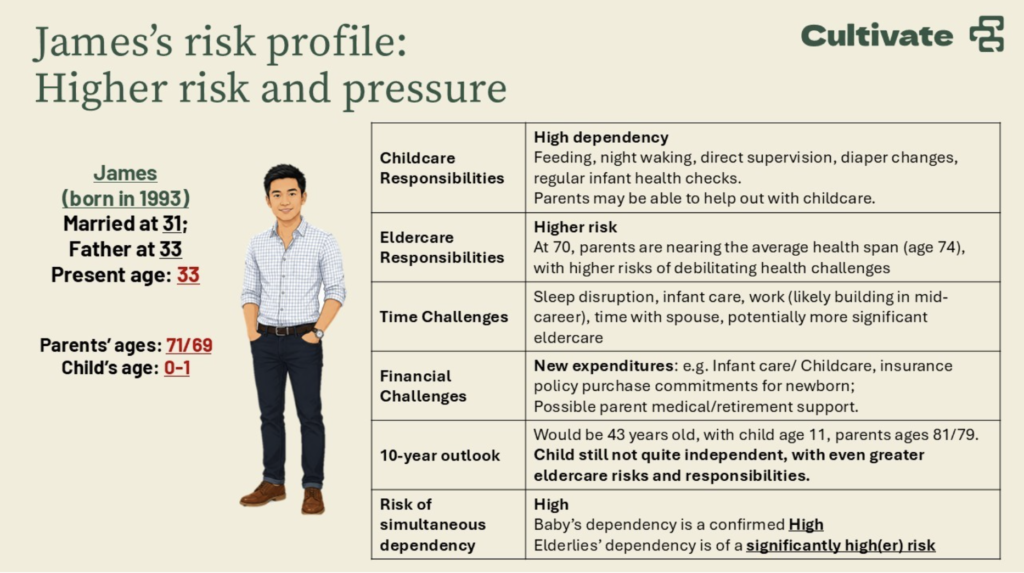
To illustrate the strain, here are three cases of a 33-year-old father in 2026: Terry, Alan and James.
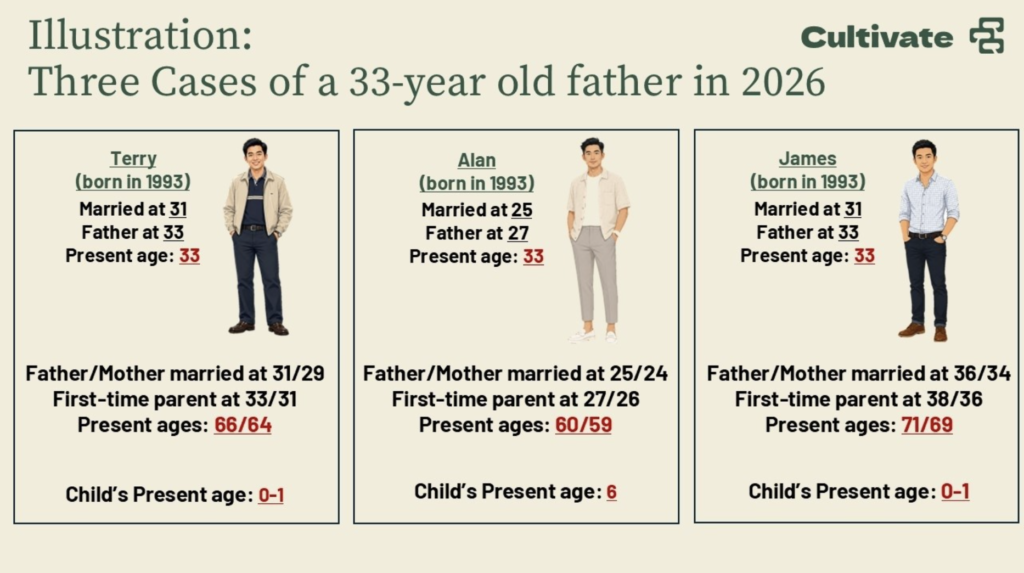
Terry and Alan are at the median age for marriage and parenthood in Singapore, while Alan married and became a father earlier than median age. However, their respective parents married at different ages, with the result that the three men have different likelihoods of facing acute sandwiched family struggles.
Terry is at moderate-high risk and pressure. His parents are in their 60s, and he is a father of a young infant.
Alan is at lowest risk of facing acute sandwiched family struggles, as his parents are relatively young and his child is already 6 years-old.
James, on the other hand, is at the highest risk and pressure of facing acute sandwiched family struggles. His parents are already around 70 years-old, and he is a father of a young infant.
Conclusion
Demographically, the risk of acute sandwiched family struggles rises with two or more generations of delayed marriage and parenthood.
Colin reflected that “life is meant to be a journey”, where people make “some right, some wrong, some good, some bad” choices, but must ultimately “just move on”.
If people and families delay marriage and parenthood for more than two generations, they increase the likelihood of a situation where couples will have to take care of both their young children and their elderly parents at the same time.
Immediate support for young families in such situations is critical to make parenthood manageable.
However, support for life-course adjustment (i.e. earlier marriage and parenthood) is the long-term sustainable solution to make parenthood more comfortable, desirable and enjoyable.