In 2025, Singapore recorded a total fertility rate (TFR) of 0.87, the lowest it has ever been. On average, a Singaporean woman would have less than one child in her lifetime.
This places Singapore third-lowest in the world for TFR, behind Taiwan (0.695) and South Korea (0.8), and far below the replacement rate of 2.1. At this rate, for every 100 residents today, Singapore will have just 44 children, and a mere 19 grandchildren.
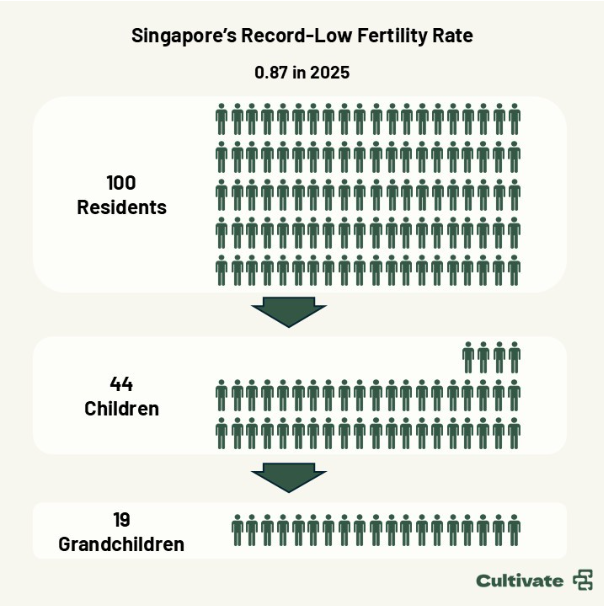
The TFR here has been below replacement levels since 1977, owing in large part to the overwhelming success of the government’s famous “Stop at Two” population control campaign, launched just five years prior. Despite numerous incentives over the years to try to reverse the trend, birth rates here have continued to fall.
In the year just before the “Stop at Two” campaign launched, there was a call in Parliament to “eradicate the old concept that large families are a sign of prosperity.”
This speech, by Parliamentary Secretary to the Minister for Culture Inche Sha’ari Bin Tadin, captures the heart and motivation of the government’s move then. It may even contain the solutions to reverse our falling TFR, once we unpack its logic.
Who Was Inche Sha’ari Bin Tadin?
Born in 1932, in Kuala Pilah, Negeri Sembilan (in Malaysia today), Sha’ari Bin Tadin was “the first Singapore Malay graduate MP” at the age of 36.
He began his career as a teacher at Sang Nila Utama Secondary School, and became the school’s principal.
Married at 25, he went on to have six children. His daughter Masturah remembered that her father was “firm” when it came to his children’s studies, and “made an effort to create an environment for us to develop a love for reading as well as curiosity about the world around us.”

1971 Speech by Inche Sha’ari Bin Tadin
The speech by Mr Sha’ari was made in the context of the government’s growing plans to more of the growing local population in high-rise flats built by the Housing and Development Board (HDB), amidst land-scarce Singapore. The government had also launched several land reclamation projects, including the ambitious East Coast Reclamation Scheme, to reclaim huge swathes of land from swamps, foreshores and other uninhabitable spaces.
During the initial phases, HDB housing designs were “simple and utilitarian” 1-, 2- and 3-room flats which came with basic amenities such as piped water and electricity, in order to quickly meet the housing demand. Due to the massive reclamation and urban building works, many families had to be resettled from their existing huts and homes into new flats elsewhere.
Against this backdrop, Mr Sha’ari spoke in Parliament, criticising the trend of low-income large families living in smaller flats:
I noticed that nearly all the large families living in H.D.B, flats were from the lower income level, in the H.D.B. one-room flats, for example, the number of occupants averaged, strangely enough, some six to eight people. Most of these people were either resettled families affected by clearance schemes or those dependent for their livelihood on hawking or other low-paid jobs such as manual labour and lorry driving. If we do not want to see our H.D.B, estates degenerate into slums because of this kind of overcrowding, our people must be made to understand the vital importance of family planning, the need to keep a family small in order to maintain a high standard of living.
He continued by calling upon Parliament to “eradicate the old concept that large families are a sign of prosperity”.
In his view, large families often mean “low family income, with the parents having to work extra hard to supplement their finances”. It also means that “very little attention is paid to the children”, which “could lead to a drop in the quality of education, at a time when education is all-important to a young and vigorous Republic determined to speed ahead.”
Implicit in Mr Sha’ari’s philosophy was an emphasis on success, driven by education. He painted a picture of “urbanisation and modernisation” on one hand, as opposed to “tradition” on the other: “Traditional practices which hinder progress have to be discarded and new achievement-orientated values imbued, especially in our young. All citizens should be motivated to reach the top.”
To this end, the Parliamentary Secretary called for “a spirit of oneness, a sense of cohesiveness, in our people”, to work towards a “common objective”:
“Sacrifice” is the key word in this context. Those people who have been affected by reclamation schemes have to sacrifice for the sake of the whole population. The Government is quite aware of the hardship and difficulties posed by resettlement. These are being minimised as far as possible. The rate for resettlement compensation has been increased, for instance. But we cannot please everybody. Some of the people will always have to sacrifice something for the sake of the common good.
“Once we accept the fact that modernisation is inevitable and adaptation is our only course of action, we will really begin our progress,” he concluded.
Traces of a Solution?
Inche Sha’ari Bin Tadin reflected the thinking of many leaders within the government at the time, stressing the perceived need to pursue achievement and a high standard of living. To this end, “adaptations” had to be made to family life and childbearing, education and our value systems as a whole.

The overarching thrust of the government, as Assoc Prof (Dr) Tan Seow Hon pointed out in her recent article on success and flourishing, was aimed at “the flourishing of the economy (rather than the individual), and on the nation having to stay competitive in the global arena”. Much less emphasis has been placed on human flourishing in a holistic sense.
Yet that speech by Sha’ari Bin Tadin may just contain within it some keys to undoing the trend of low birth rates here in Singapore, in highlighting the areas of policy and values that we need to reverse.
We will unpack these in our next article.