“Parenthood aversion is not merely about the affordability of children. It is whether Singaporeans believe that family life is worth re-ordering their lives around, and for.”
That was the thrust of a supplementary analysis titled “Eyes on the Price”, presented by research and policy lead Daniel Lim at our Cultivate Commune breakfast conversation held on 28 March and released on the very same day.
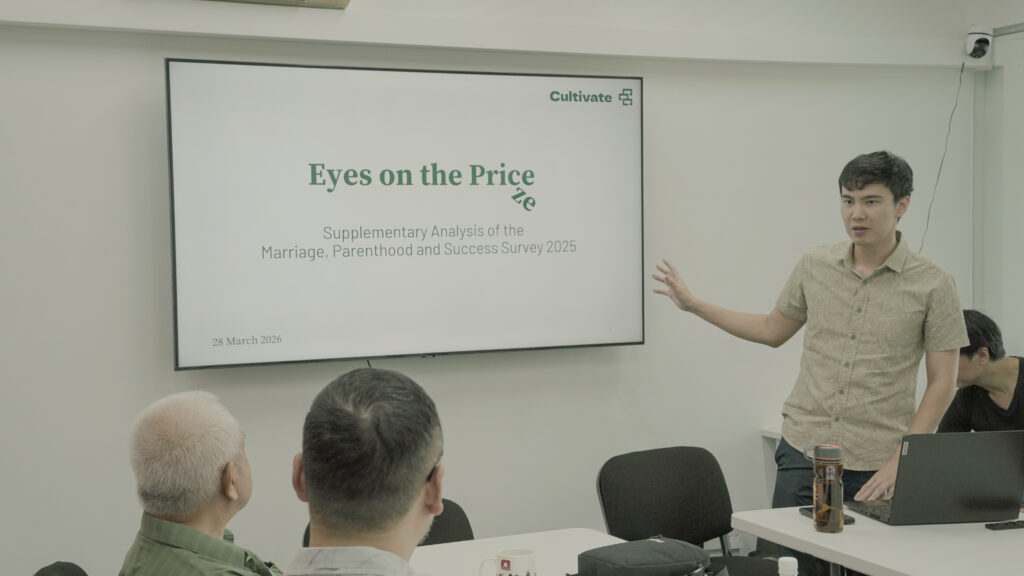
The analysis builds on Cultivate SG’s previously published “Marriage, Parenthood and Success” Survey 2025. Our 2025 survey explored individuals’ various levels of orientation towards marriage and parenthood (MPO). This supplementary analysis of the same survey examines how respondents of different life status and MPO differ in their perception of prize and price of parenthood.
Are Finances Really the Issue?
Singapore’s total fertility rate hit a record-low of 0.87 in 2025, the furthest below the replacement rate of 2.1 it has ever been. Finances tend to be the top reason frequently given by Singaporeans as to why they are discouraged from having children.
Yet, in 2021, the Straits Times published a close-up interview with four women who did not want children. “Interestingly, if you watch the video, none of them mentioned finances,” Daniel noted.
Instead, the reasons involve things like preferring one’s independence, enjoying the peace and quiet, or the fear that having put in the sacrifices for their children, they might one day turn around and say, “I don’t like you or I hate you.”
Similarly, in a “childfree” bingo card that had been posted online, only one of the 24 boxes is explicitly about money, with a few others being somewhat related to finances. “There’s a lot to do with lifestyle, career, having to adjust your lives, rather than the cost of raising a child financially.”

Daniel explained that, in our supplementary analysis “Eyes on the Price”, we analysed four respondent groups:
- MNC (Married, No Child) – Married individuals with no child and have no aspiration to become parents
- PMNC (Potentially, Married and No Child) – Singles who aspire to marry but not to become parents
- MNCY (Married, No Child Yet) – Married individuals without children but do aspire to become parents
- MP-H (Married Parents, High MPO) – Married parents with a strong MPO, meaning that they view marriage and parenthood positively, and have aspirations for marriage and parenthood
When parenthood is perceived as a prize, its price undergoes “price-inelasticity” (i.e. less sensitive to the costs / challenges of parenthood). This means that one can be faced with numerous challenges in life, but a person who prizes parenthood would still want to be a parent and is less deterred by those challenges.
The converse is true; when parenthood is not prized, it becomes highly “price elastic” (i.e. more sensitive to the costs / challenges of parenthood). Thus, for someone who does not prize parenthood, “any reason can be a very good reason not to be parents”.
Atomisation of Society
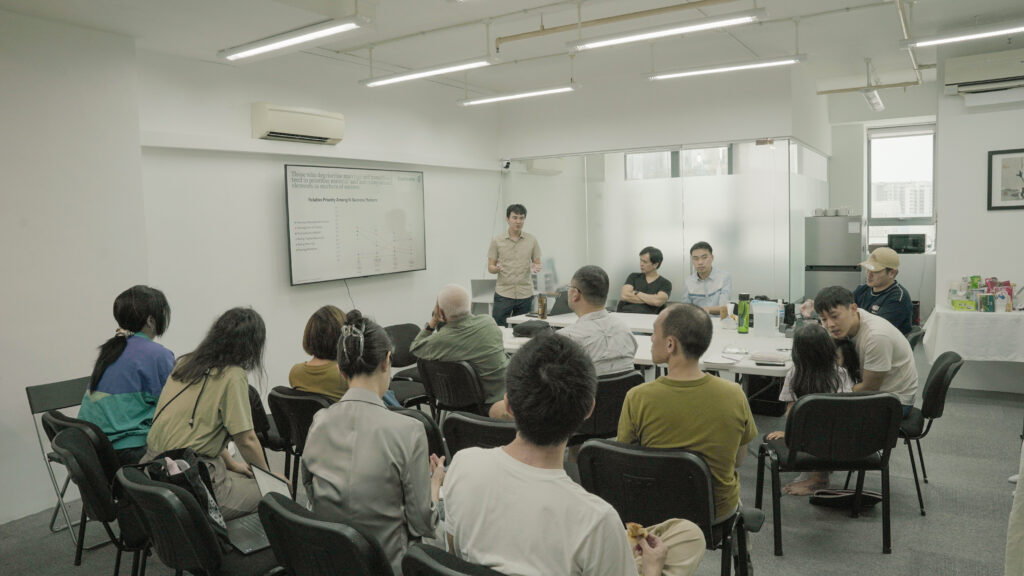
One of the participants commented that we are becoming more “atomised” in our modern society, and that even if there is a family, it is a “family alone”, in a big ocean with “no one helping”. There is an illusion of empowerment that comes with a system that is essentially telling people “do it yourself”, whether it is in the context of parenting, career or more.
In response, Darius Lee noted that fraternity is breaking down, citing the Institute of Policy Studies “Singapore Perspectives” conference earlier this year. As a result, people become much more “atomised”.
“People in our post-Covid era have become a lot more germophobic, a lot more inhospitable, a little bit more insular,” he said. They feel more hesitant to engage with others, or “even just to have your friend’s kids over at your house. Never mind that they play and make a mess and everything like that; next time I’ll do it to your house.”
Does the government have a role in addressing the atomisation of society?
“Yes and no,” said Darius. On one hand, the government can create conditions where fraternity can be rebuilt. On the other hand, it goes down to our day-to-day interactions among neighbours, friends, family and community. It takes time, energy and effort, which are scarce in Singapore due to our work culture. Nevertheless, it is worthwhile to get the whole community to pitch in to raise children. As the saying goes, “it takes a village to raise a child”.

Narratives and Policies
Something to think about, is changing the narrative, noted our chairperson Ariel Lim. Prevailing narratives think of “kids being a burden”.
Citing the “Stop at Two” population control campaign launched by the government in the 1970s, Daniel noted how this created a culture which thinks that “children are too difficult to have”. He believed in the importance of building a space where families can thrive. That includes going back to the earlier years of education, for schools include discussions about family life and encourage young people to think that family life “is something worth pursuing”.
Part of the discussion during the Commune focused on government policies, especially on maternity leave.
One participant shared that she works in a company that has “extremely generous” maternity leave policies, above and beyond what the laws in Singapore require. Mothers in this company are entitled to six months paid maternity leave, plus another six months unpaid maternity leave.
On the other hand, eligible working mothers are currently entitled to 16 weeks of Government-Paid Maternity Leave (GPML) in Singapore. For the first and second children, the first eight weeks of maternity leave are paid by employers, while the remaining eight weeks are reimbursable (subject to a cap of $10,000 per 4 weeks or a total of $20,000 per child order). For the third child onwards, all 16 weeks are reimbursable.
There is room for reform, and Cultivate has advocated for a revision to the maternity leave scheme, to make all 16 weeks reimbursable regardless of birth order.
Values, Priorities and Culture
People are Singapore’s only natural resource, and a vibrant population is necessary for Singapore’s survival and competitiveness.
However, speaking on behalf of Cultivate, Darius said that fertility is not something that Cultivate SG pursues “in and of itself for its own sake”. Instead, our low fertility rates are a symptom that something is not right in our “wider culture and ecosystem”. It involves our values and priorities, attitudes towards the roles of men and women, family, children and more.
“Maybe we need to focus our eyes on the right thing. All eyes on the prize.”