Good morning. Welcome back. I’m Daniel. I’m also a father of three, apart from working here.
And, usually, when I introduce myself that way, I get the same kind of responses. People are either very shocked, in disbelief or maybe some of them who are closer to me might joke about it and say, “You are like some ideal Singaporean. You know, you’re having kids early, getting married early, and have more than two.”
So this is something quite interesting because, again, I didn’t work with Professor (Tan Seow Hon) to prepare the slides but, somehow, we both talk about the same thing, which is actually about the Singapore Dream.
It’s quite funny to me because, whenever I hear comments like this, I have to wonder: Is this really a Singaporean Dream to have a family early and to have more children? Or is it just like Singapore’s dream to be self-sufficient in terms of its replacement rates?
And I think I have an inkling of what the answer looks like for the younger generation.
From the comments I received last year, during the extended family gathering at the Chinese New Year celebration, my wife’s 15-year-old cousin actually saw her, with the third one in the oven, and she exclaimed, “Three kids? In this economy?”
As funny as it sounds, I think, the phrase “kids in this economy” – whatever number in front that might be – kind of sums up what young people feel towards parenthood these days.
Like our theme for this year, I think indeed, family life is kind of on trial. Marriage and parenthood do not seem to be a part of the Singaporean Dream.
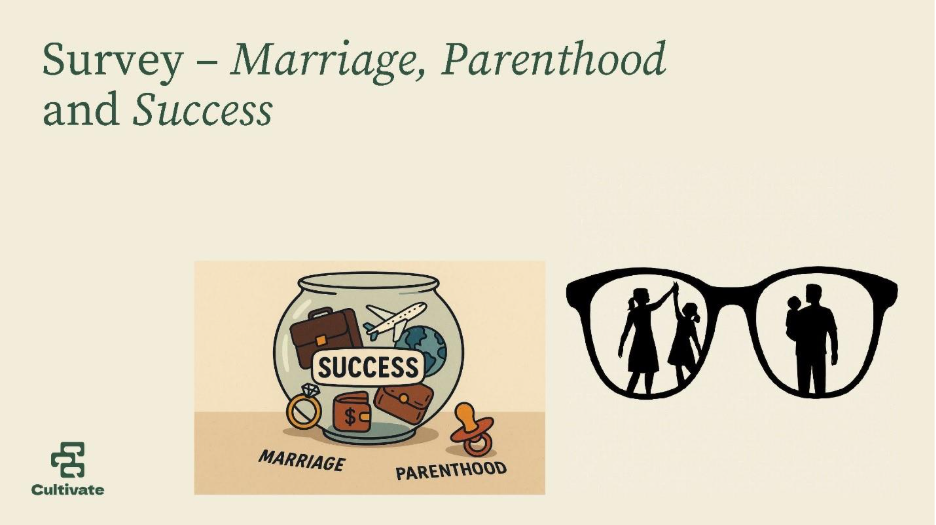
In this year’s survey, we set out to explore how Singaporeans look at marriage, parenthood and success. We wanted to better understand how Singaporeans perceive success in life or the Singaporean Dream, and how marriage and parenthood feature in this picture of success.
To do that, we looked at Singaporeans aged 21 to 45, whether they carry an orientation towards marriage and parenthood, and how if such an orientation – or the lack of it – might impact their attitudes and beliefs or choices regarding marriage and parenthood.
We commissioned Pureprofile, a global data and insights organisation, to conduct an online survey reaching 2,019 Singapore citizens and PRs (Permanent Residents) between ages 21 and 45.
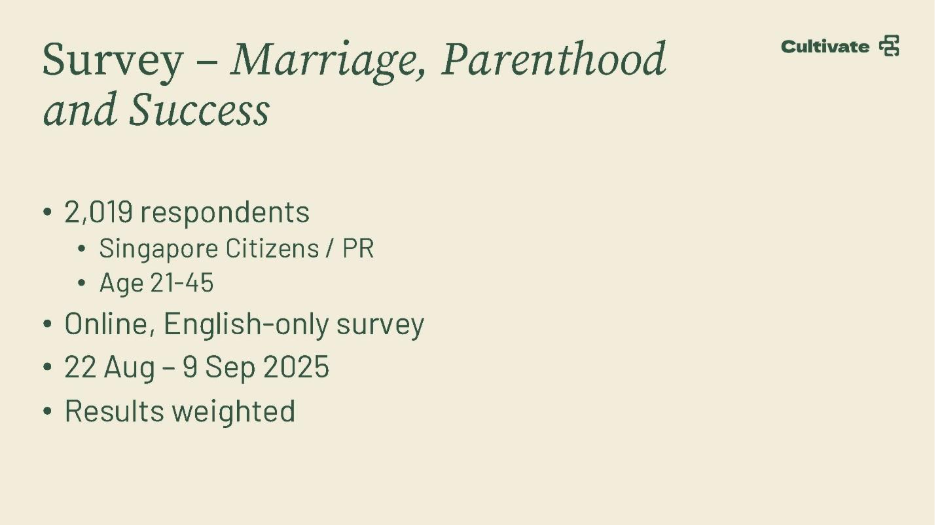
We have targeted this age range because this is broadly the range where people are getting married and having children.
Our results showed that:
- People with positive views and aspirations towards both marriage and parenthood are less likely to delay marriage.
- Those who value marriage and parenthood more are looking at having a child as a more essential element within marriage.
- When it comes to what makes an excellent parent, the top traits are valuing safety, stability and being an involved parent. While fathers and mothers are generally aligned in this area, we do see differences when comparing respondents across how much they value marriage and parenthood.
- When we look at this, we think of whether being a parent is easy or not, a lot of people say that financial considerations are very important to them in terms of being discouraged to be a parent in Singapore. But, for those who highly value marriage and parenthood, they are less deterred by the various kinds of factors we posed to them as well, in terms of how much it will discourage them from becoming a parent.
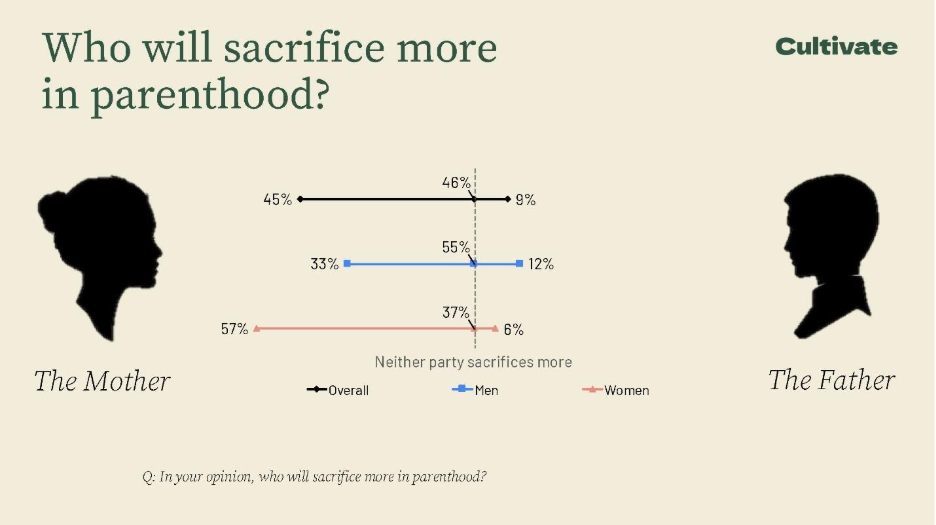
- When we look at the question on who sacrifice more in marriage or in parenthood, about half of the women say that women would sacrifice more, while the men are a lot less likely to say so.
- Coming back to the Singaporean Dream, the top marker of success on the overall is character-related. Being married and having children, as I mentioned earlier, are indeed among the lowest of importance as a success marker in life for Singaporeans. But for those who highly value marriage and parenthood, their views are very different.
Now I’ve already mentioned this term; you have heard me say “those who value marriage and parenthood” quite a few times. And this is quite important because when you read our report –which will be uploaded very shortly on our website – we use this term “marriage and parenthood orientedness” (or MPO, in short) to describe how people are interested and aspire for marriage and parenthood. So we analysed the data using this framework: the categories of MPO-ness.
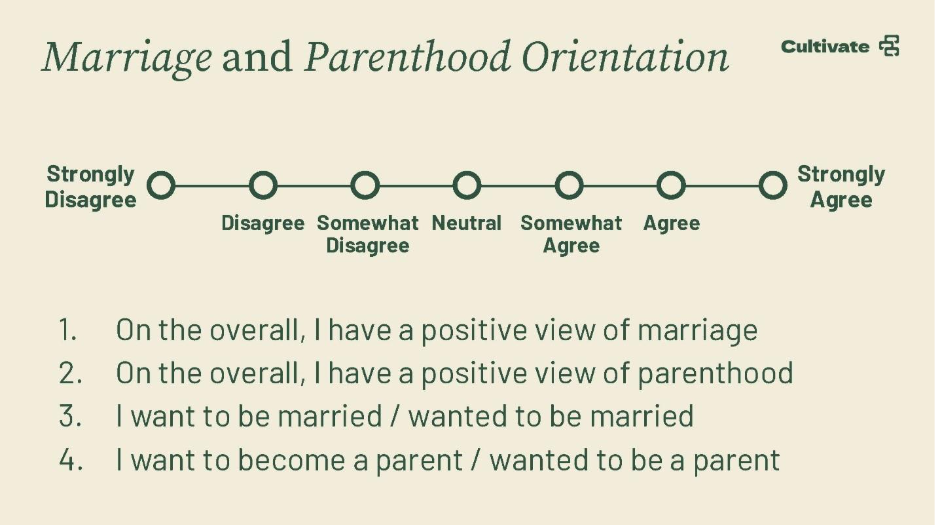
Here is how we have constructed this profile. Looking at this slide right here, you have four questions, and you can try this for yourself. We asked respondents these questions, on the scale of 1 to 7, how much you disagree or agree.
- Would you say that on the overall you have a positive view of marriage so you can try it yourself? Just take a mental note of how you will be answering this, and later I will reveal perhaps, which category you yourself fall under, in terms of MPO-ness.
- And now what about a positive view of parenthood?
- And if you are unmarried today, would you say that you want to get married? And if you are already married, do you want to be married?
- Or if you don’t have children, do you want to be a parent? And if you already are (a parent), would you say that you wanted to be a parent?
So if you have answered strongly disagree or disagree, somewhat disagree or neutral to all four of four statements, you would belong to the Non-MPO category, for you have shown towards marriage and parenthood either a disinterest or even a little bit of disdain. You don’t think this is something important, you don’t think that this is a positive thing for life or for society or just for yourself.
And if you have answered, agree or strongly agree to all four statements, then you would probably be classified under High-MPO category where you have strong aspirations for marriage and also a very positive view of both marriage and parenthood.
And if your answers are somewhat mixed, like most of our respondents, then you will find yourself under the Moderate-MPO category as you are neither against nor enthusiastic about marriage and parenthood.
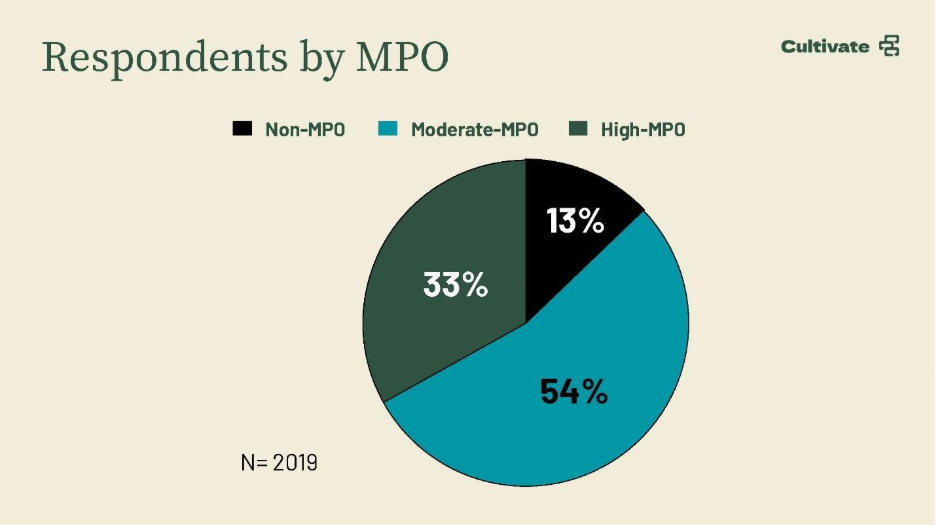
So this is our breakdown of our respondents. About one in three classify to have High-MPO, the majority (54%) Moderate-MPO and slightly more than 1 in 10 (13%) for under the Non-MPO segment.
So just a quick show of hands. How many of you – if you all remember your answers – find yourselves under High-MPO? Okay, there’s quite a lot here.
What about Moderate-MPO and Non-MPO? Anyone? Okay. If you are shy about it, it’s okay.
Looking at this MPO-ness is quite important because for the rest of this presentation, you will see how it actually affects people’s views on marriage, parenthood and success.
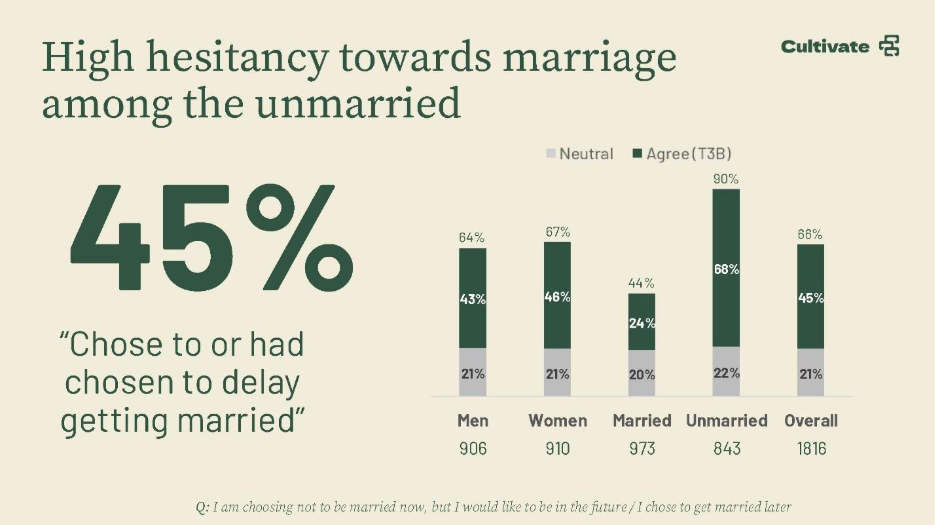
I talked about the first finding. The key finding about the those with a higher view of marriage and parenthood are less likely to delay marriage on the overall, 45% of our respondents say that they have chosen or will choose to delay marriage. This is something that is quite different if you look at those who are unmarried and those who are married. Among the unmarried, openness to delay marriage is very high, it’s actually 9 in 10.
For the singles, almost 7 in 10 say that they are choosing to delay marriage for many different reasons. And this inclination to delay is actually similar across the sexes.
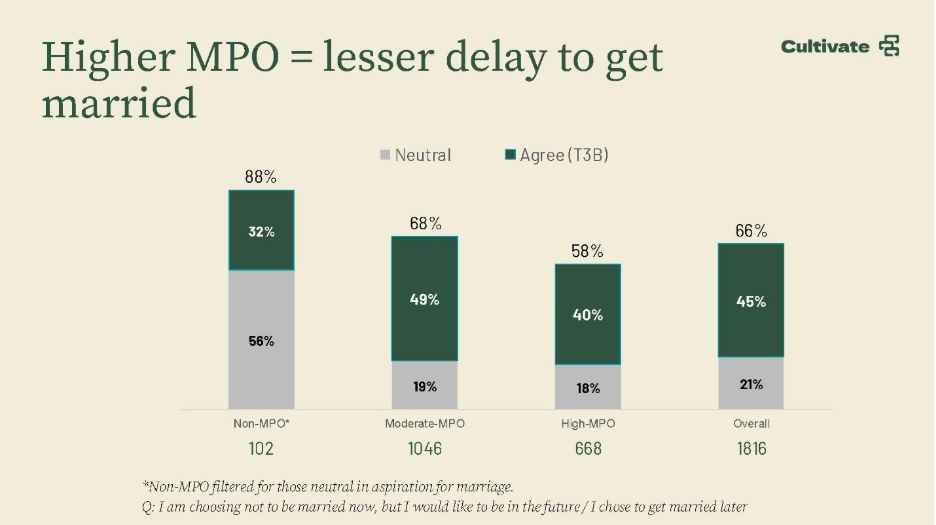
But if you look at it across the MPO profiles, you will see that for the High-MPO, they are less likely than the overall population to choose to delay marriage. And for the Non-MPO, they have a lesser proportion of people who say that they are choosing to delay, not because they think that necessarily, but probably because they did not even indicate an interest in marriage in the first place. So for them who, qualified in this statistic, they are those who answered neutral towards aspiration for marriage, and that’s why the figures look like this.
If we look at the profile for the men according to the MPO, again you see the same pattern. The higher the MPO, the less likely to say that they are choosing to delay marriage. But compared to the overall level, they are again lower, in terms of openness to delaying marriage, and only about 55% as compared to 66% earlier.
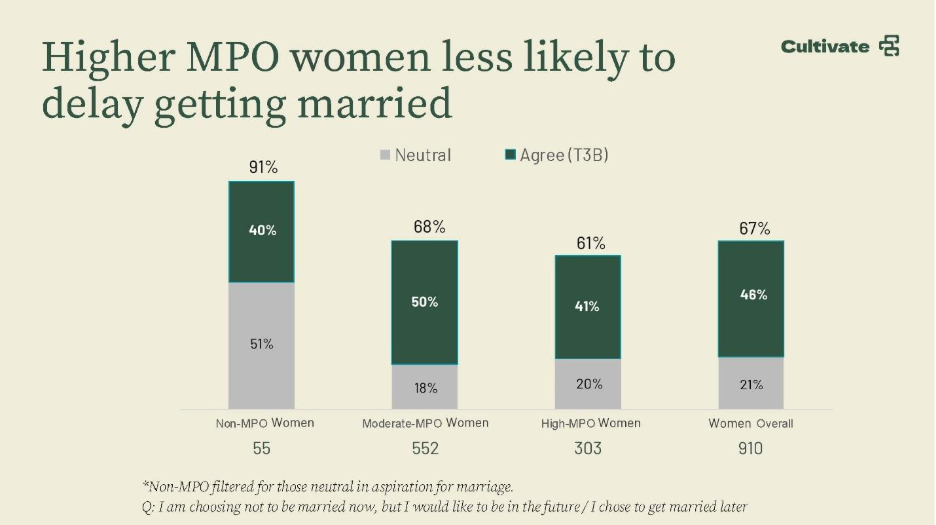
Over to the women, again higher MPO women are less likely to say so. But if you noticed, women on the overall are more inclined to say that they are delaying marriage or they are choosing to do so. But, that said, it’s still lower than the 66% overall for the High-MPO folks.
Over here are the conceptions of marriage.
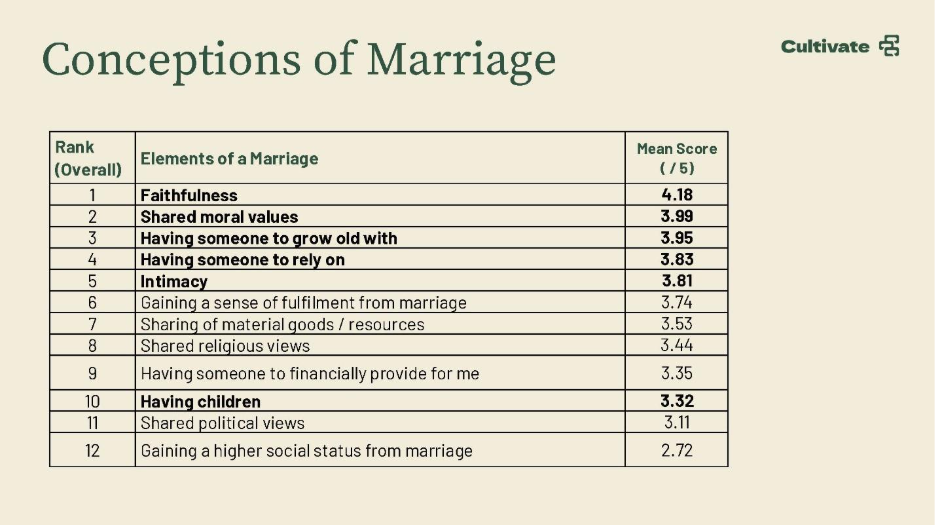
We looked at 12 elements of marriage: What do the respondents think is important to define a marriage? So we asked the respondents to rate each of these elements on a scale of 1 to 5, 5 being extremely important an element for marriage. And looking at the mean score, we have “Faithfulness” and “Shared Morals” emerging as the top two elements, and “Companionship” and “Dependence” followed very closely. “Intimacy” made it to the top 5.
Each of these have at least a 3.8 out of 5 in importance for marriage. And if you are trying to look for where does “Children” stand in terms of the these elements, they are actually in number 10 out of 12.
So this suggests that, on the overall, respondents don’t really feel or consider children to be an essential part of marriage.
But this picture changes when you look at the High-MPO people. If you look at it this way, the Non-MPO indicated a perhaps more romanticised picture of marriage than the High-MPO. They placed having someone to rely on in a much higher position, 3rd place. And on the other hand, the High-MPO folks, they draw a greater sense of fulfilment from marriage itself. And they are also more likely to say that “Having Children” is a more important element in marriage, ranking somewhere in the mid-tier, 7th out of 12.
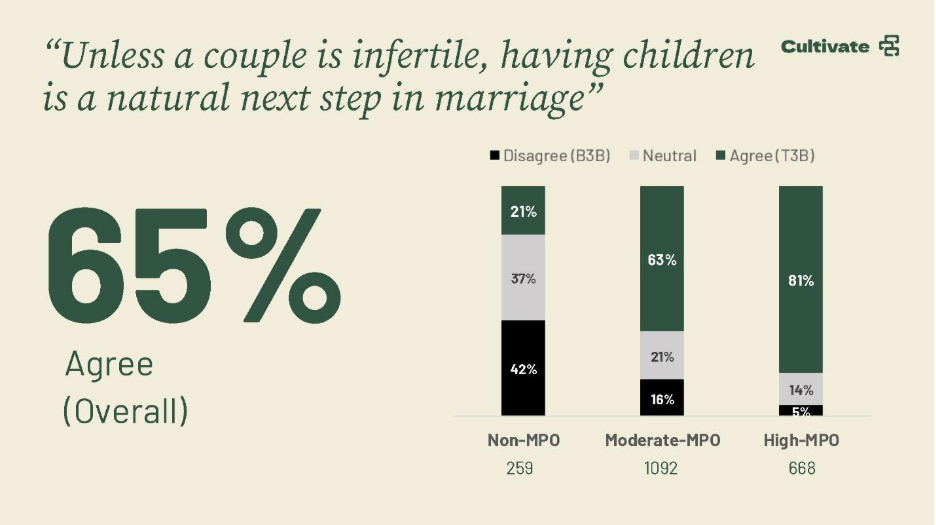
And I also asked them: What do they think about this statement, “Unless a couple is infertile, having children is a natural next step in marriage.”
On the overall, more than 6 in 10 agreed. The Non-MPO are pretty split about this. But a high number of them actually inclined towards disagreeing on this point. At least 4 in 10 of them disagreed. For the High-MPO, 8 in 10 feel that it is indeed a natural next step in marriage to have children.
What do they think about parenthood? Does it take marriage to a higher level? Here, almost 3 in 4 agree. Again, the Non-MPOs are quite split; about one-third across each of the answers that they can give. And the High-MPOs are almost unanimously in agreement with this; more than about 9 in 10 of them agree with this statement.
So what do all these say?
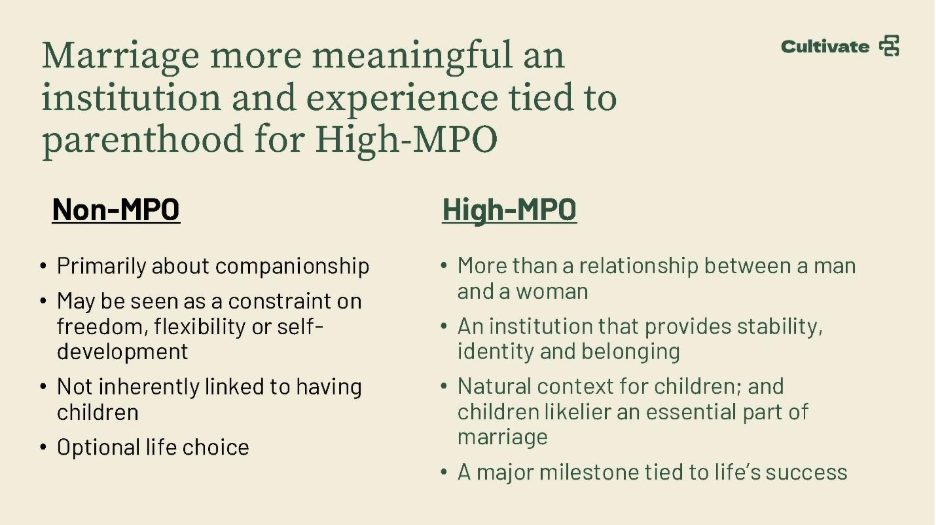
It may not be a surprise to see that the High-MPO folks are a lot more interested and positive in their views towards marriage and parenthood. But they do tell us one thing, that is, MPO levels do affect how one thinks and conceives the idea of marriage and, also later on, parenthood.
If we compare, in the summary between the two of them for marriage; for the High-MPOs, marriage is more than just a relationship between two people, between a man and a woman. It is a meaningful institution that provides stability in identity and belonging, and is also seen as a natural context for having children. And parenthood is much more likely to register as an essential part of marriage to them.
On the other hand, non-MPO individuals might view marriage more as an optional life choice, not a core life goal to achieve, and also is more primarily about companionship. And there is no inherent link to having children, when it comes to marriage.
We also asked about what do they think about what makes an “excellent parent” or what is “excellent parenting”.
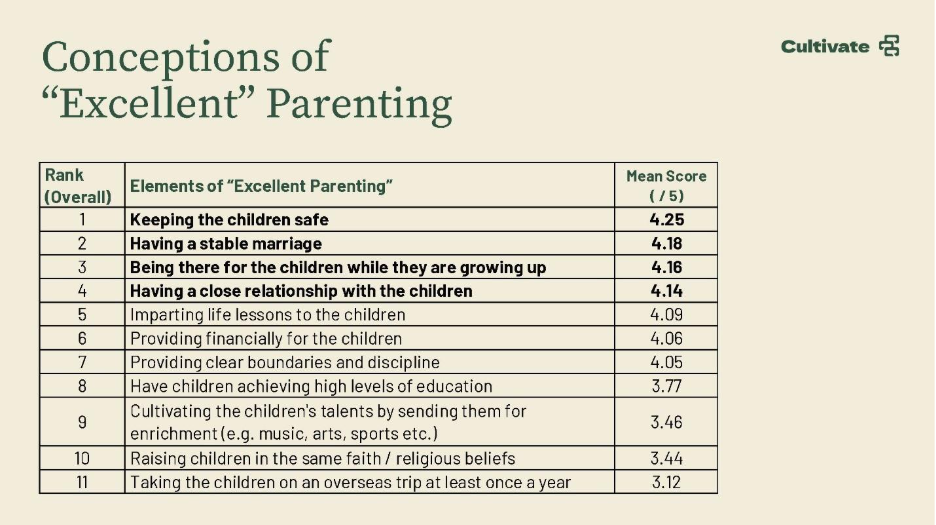
On this we gave them 11 items. Again, we asked them to rate the importance from a scale of 1 to 5, and “Safety and Stability” or “Presence”-related items emerged as the top four.
And when we try to look at the comparison between how mothers answered this and how fathers answered, we noticed that there’s relatively fewer divergence in views.
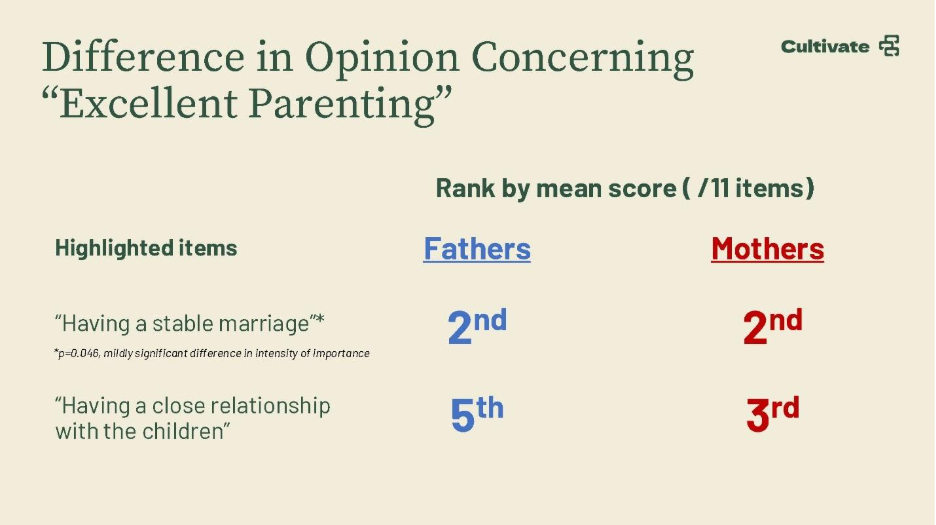
Only two areas. One of them is – to a very small statistical significance – having a stable marriage. Mothers tend to rate it a bit higher. But at the same time, if you look at the rank, they actually rank the same; 2nd most important trait. But mothers do prize having a closer relationship with the children more than the fathers do.
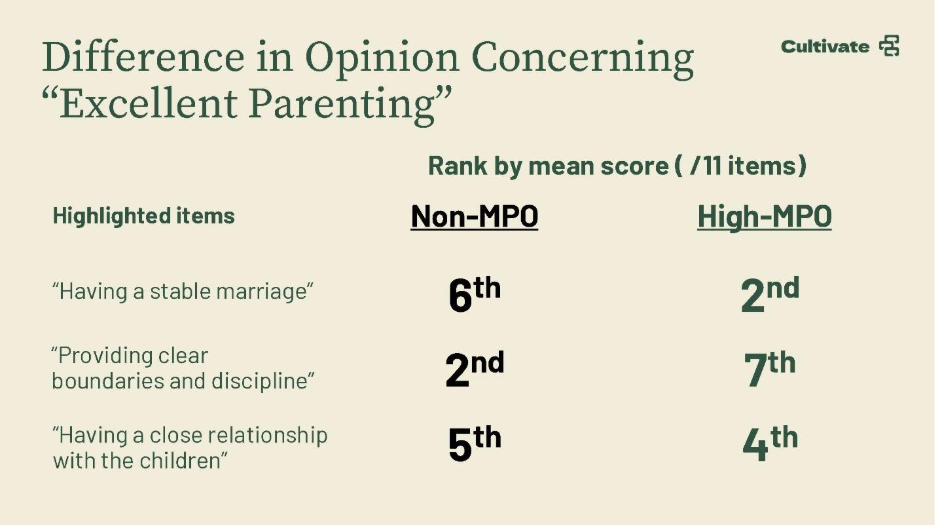
If we look at this in terms of MPO-ness, you see that the picture changes quite significantly. The Non-MPO value marriage less, and they will privilege the whole idea of being a parent who is, being able to nurture the child in terms of providing them with boundaries, discipline, or education about how to be a good person as a more important trait of excellent parenting; while the High-MPOs value marriage stability a lot more and also having a closer relationship with the children.
We asked them about the ideals: Is it ideal for children to be raised within a marriage?
Almost 8 in 10 agreed with this view on the overall.
Again, there’s more disagreement and a lower optimism observed among the Non-MPOs. About 1 in 4 of them disagreed, which is significantly less from those who are Moderate and High-MPO.
If we look at them again, as a summary, you will see that the high MPOs would indeed value marriage as an institution for parenting and a suitable context for it. On the other hand, Non-MPOs have a lower view of marriage as something for parenthood or for children.
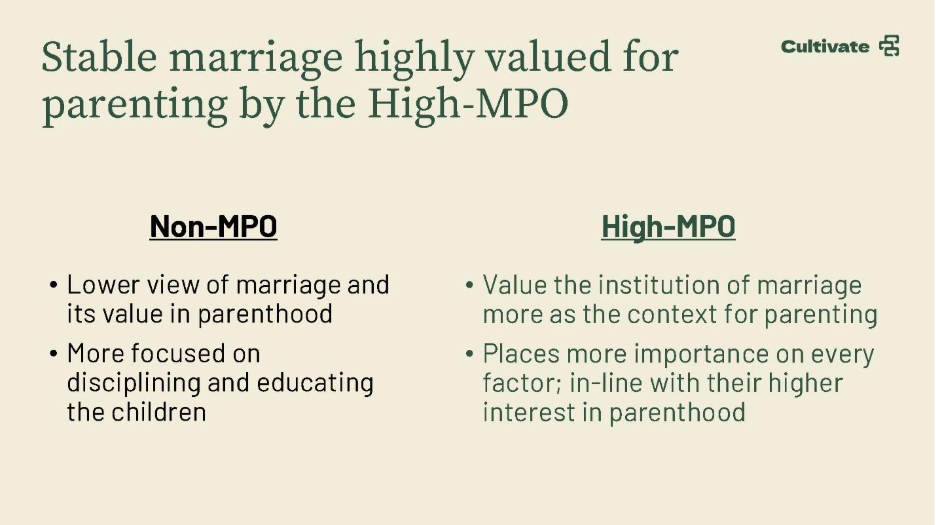
If you read our report, you will see that the High-MPOs placed a higher importance on every factor, and that is expected because they are more interested in parenthood after all.
So for this part, is the part where maybe it gets the policymakers’ interest. We are looking at some of the factors that would discourage people from having children in Singapore.
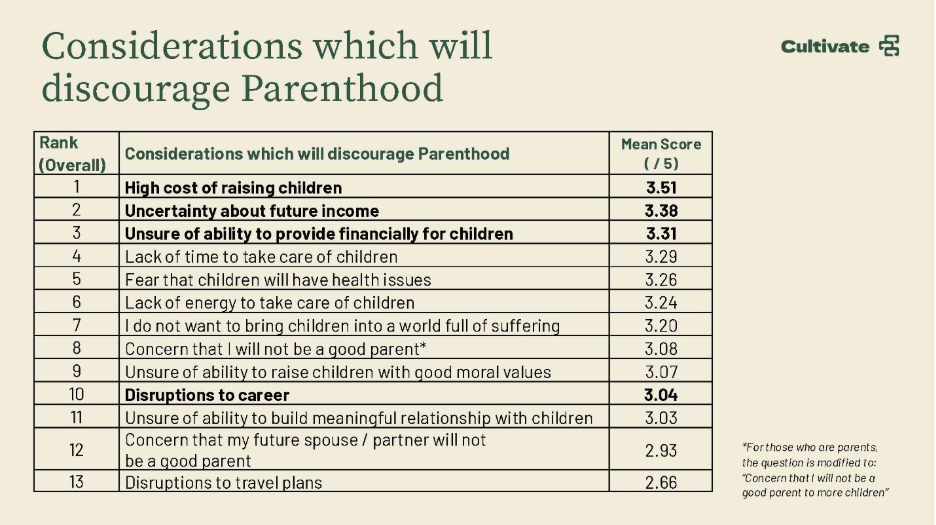
We asked them 13 different items. “Finance”-related items emerge as the top three.
Yet, interestingly, if you look at the table, you’d realise that disruptions to career actually ranked much lower, at 10 out of 13.
So what does this suggest?
It might suggest that, while people are concerned about affordability as a parent in Singapore, they are possibly open to more creative and flexible work arrangements in order to achieve that, because they are not so concerned about immediate disruptions to career.
And if we look at this across the MPO levels, the High-MPOs are more concerned with things like potential health issues for the children, while the Non-MPOs there is not so much of a concern, possibly because they didn’t really think of this as a real situation, more hypothetical to them, since they are less likely to want children.
And for the Non-MPOs, they seem to be more pessimistic about the world we live in. And they therefore say that they do not want to bring children into such a suffering world. So they are also less, optimistic about their ability to provide financially for the children.
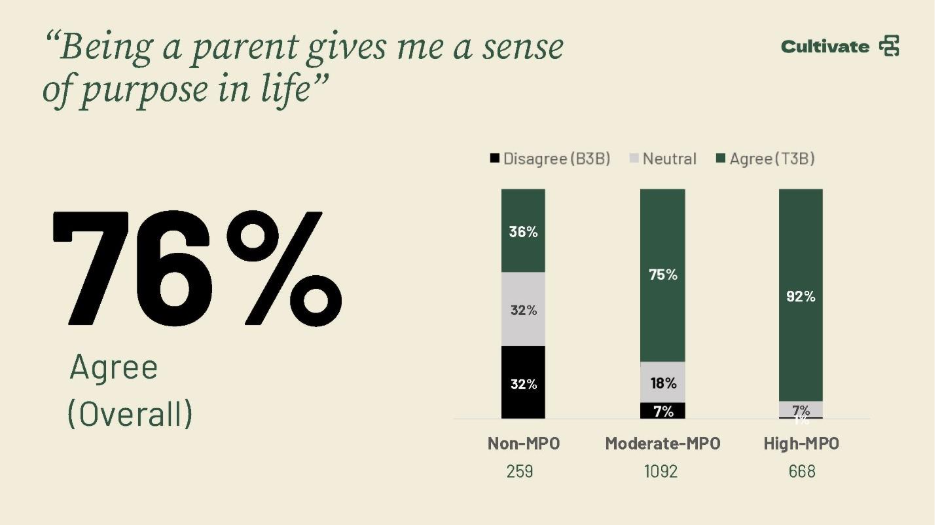
We also asked them about: Does parenthood give you a sense of purpose in life?
Not surprisingly, the High-MPOs are very overwhelmingly in agreement with such a statement. They say, “Yes, parenthood does give me a great sense of purpose.” But one-third of the Non-MPOs would disagree, another one-third are very neutral about this.
So it does seem like a sense of purpose, fulfilment or meaning behind parenthood helps the MPO cushion the impact of these various factors that would discourage someone from becoming a parent.
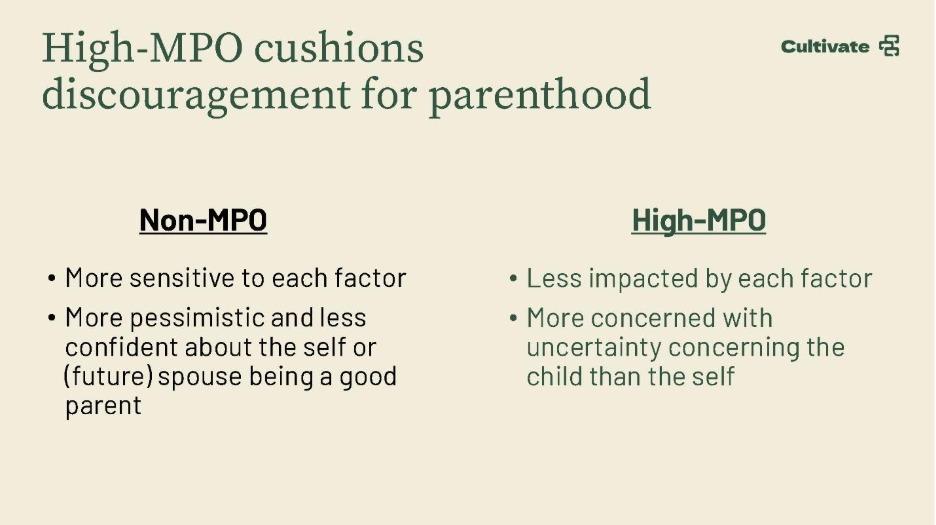
The Non-MPOs are a lot more impacted and sensitive to each factor. They scored a lot more for each of them as compared to those with higher MPOs, and they appear a lot more pessimistic and less confident about either themselves being a good parent or their future or current spouse being a good parent.
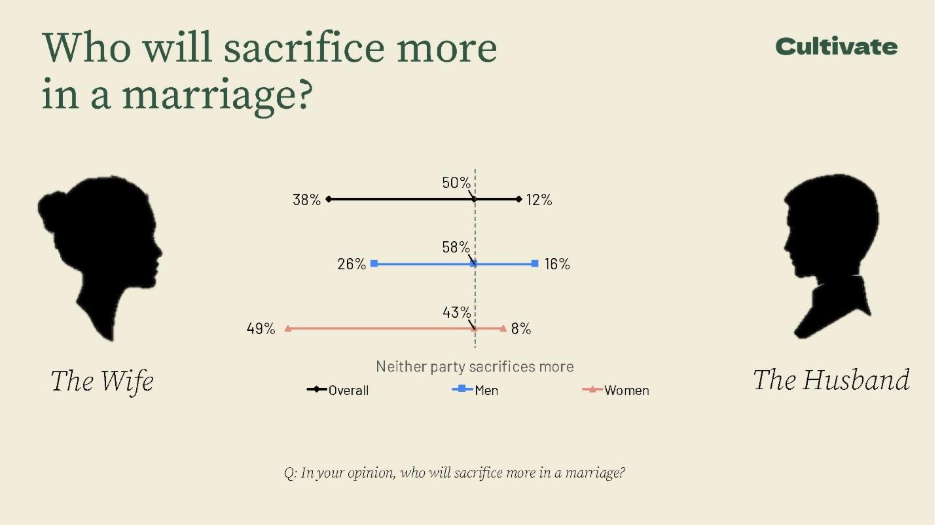
And now to the more contentious question: Who would sacrifice more in a marriage?
Most of our respondents are kind of neutral on this. But for those who did give a preference, most of them lean towards the wives, of course; 4 in 10 said that wives would do so, only 1 in 10 say that husbands do so.
And interestingly, women are almost twice as likely than men to say that the wives will sacrifice more. If you look at it across the different ways of categorising the men, across all categories, men are a lot less likely to say that the wives are the ones sacrificing more.
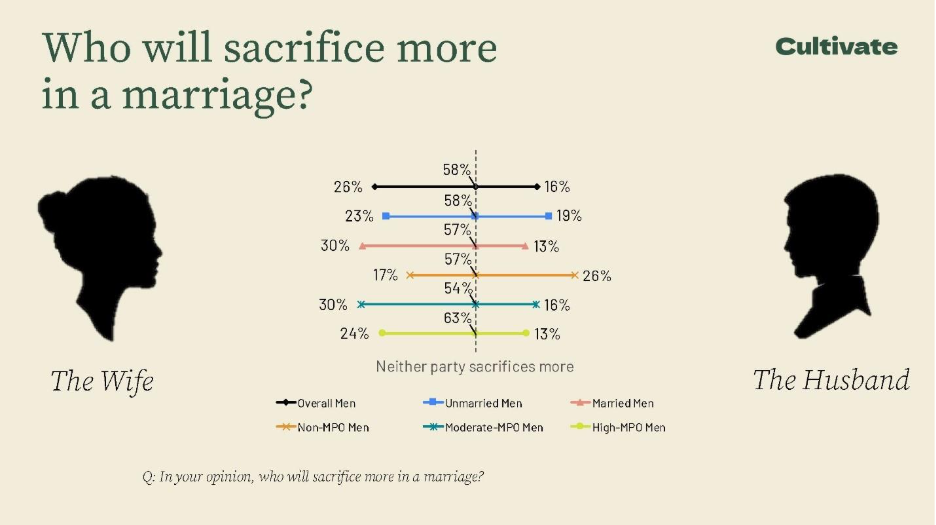
But in particular, if you look at the Non-MPO, they’re the special group because they’re the only ones that indicated the husbands would actually sacrifice more in marriage. Across the board, neutrality is pretty high for the men.
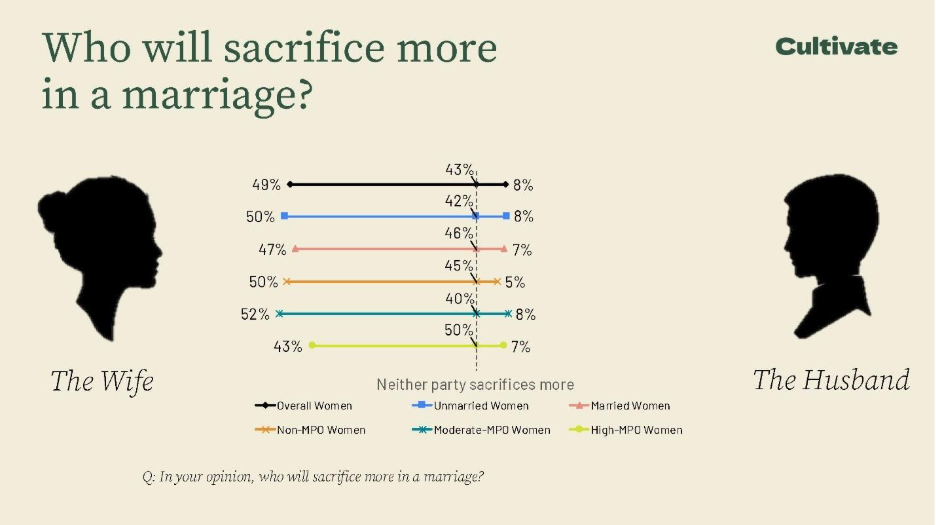
On the opposite end, if you look at the women, it’s really a different picture.
Across all of them, the majority of the women say that the wives are the ones who give up more in marriage, and 1 in 2 High-MPO women do not lean on either side of this; only about 4 in 10 say so.
This, if you compare to the previous chart, stands in great contrast. So, obviously we have a big difference in terms of how men and women look at themselves in a marriage, how much they’re giving and stuff.
So I think this is an area where the two sexes have to start talking about better, and not try to run on their own track, as this will sow more division in the society and in family.
And when we look at parenthood, the picture is very similar. Again, more women say that mothers will sacrifice more in parenthood. There’s a bit less, in terms of people who say that fathers give up more in parenthood.
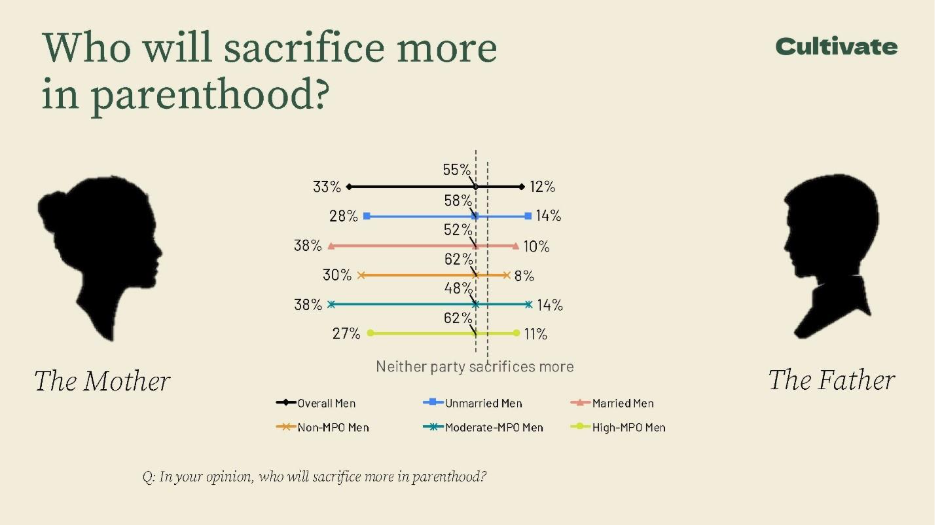
Again, when we look at it across the various male groups, neutrality dominates their answers. The Moderate-MPO and married men are most likely to say that mothers will sacrifice more. But at this time, the Non-MPOs are actually the least likely among the men to say that fathers sacrifice more in parenthood.
So why is the difference over here? My suspicion is that the Non-MPOs do not see the inherent connection between marriage and parenthood in the first place. And that’s why when they answer across these two questions, it’s likely that they’re going to answer it quite differently.
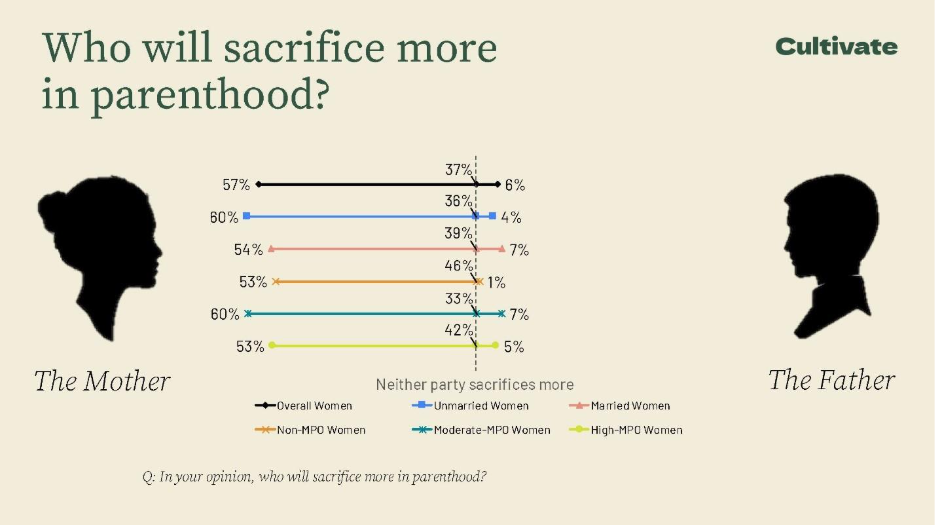
And similarly for the women, again, a lot more women are going to say that mothers sacrifice more in parenthood. The pattern is similar across the board. They are most likely to be neutral about it; similar to the Non-MPO men.
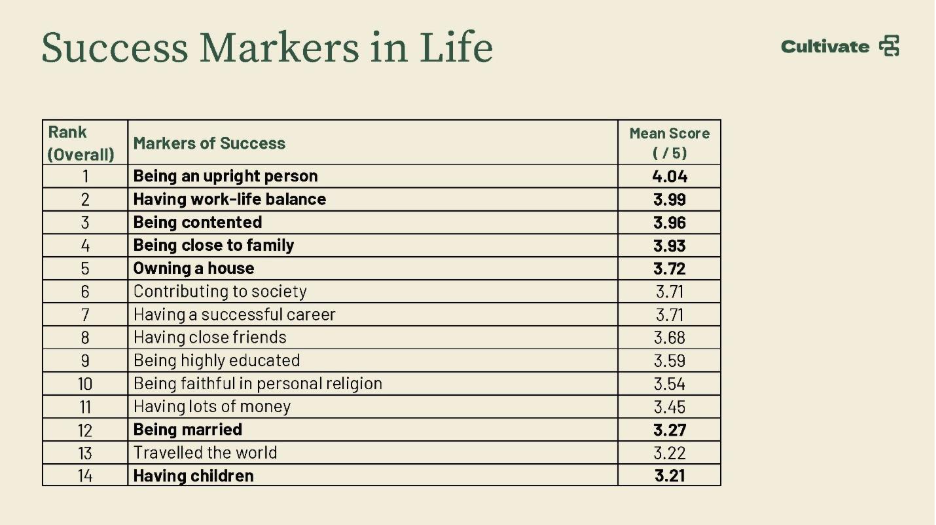
Moving on to the markers of success, we have given them 14 items in total, weighting in the same way on the 5-point scale. “Character” emerged to be the top marker of success followed by “Work-life Balance”, “Being Contented”, “Being Close to Family” followed next and then “Owning a House” – which sounds very Singaporean. “Being Married and Having Children” ranked 12 and 14.
So, the results actually confirm my suspicion that being married and being a parent do not register very highly in the Singaporean Dream.
Comparing across the Non-MPO and High-MPO, we actually see something quite interesting. The Non-MPOs are more likely to prioritise having more money. They rank this as a pretty high marker, 5th amongst the 14, while the High-MPO ranked at the second-last, 13th place.
The Non-MPO, on the other hand, place being a parent or being married at the lower end, all the way at the end, while the High-MPO, they still didn’t register this as the most important thing for them, but it moves up quite significantly to the 9th and 11th positions respectively.
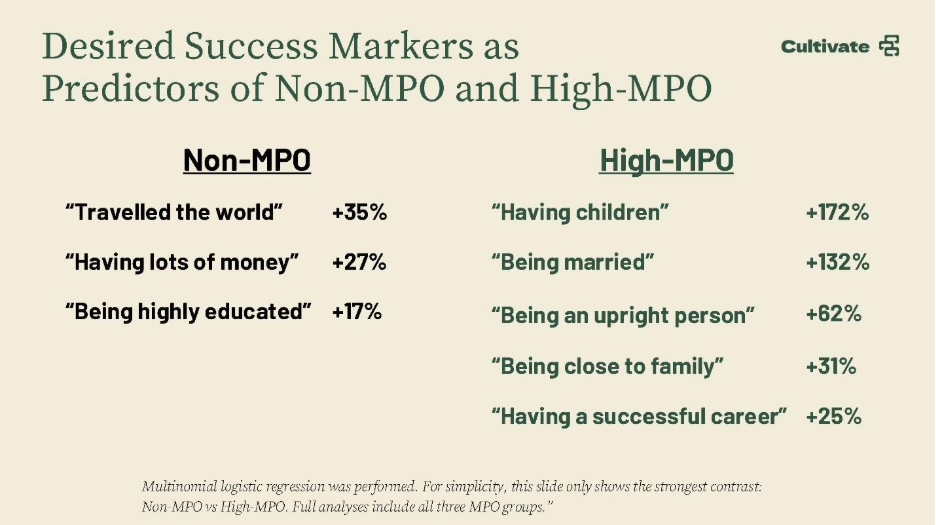
We also ran our data through some regression models. We wanted to understand whether or not it’s correlation or do we have some kind of predictive ability. If we look at how someone looks at markers of success – and it’s quite interesting – we did find something now for the Non-MPO paradigm.
If people answered higher in terms of “Travelling the World”, “Having Lots of Money” or “Being Highly Educated” in comparison to the other markers that they have also scored, then the rates of them being Non-MPO increases.
So, “Travelling the World” as a marker of success actually increases it the most, 35%.
Now, on the other hand, there are five markers that increase the probability of someone being classified as High-MPO. Of course, the strongest two are “Having Children” and “Being Married”. These two more than double the chances of someone being classified as High-MPO. These two predictors do not exhibit any problematic multicollinearity, but they do actually reflect a real substantive relationship.
Interestingly, “Being an Upright Person” is also a marker that increases the chances for High-MPO. And “Being Close to Family” is 31%, while “Having a Successful Career” is at 25%.
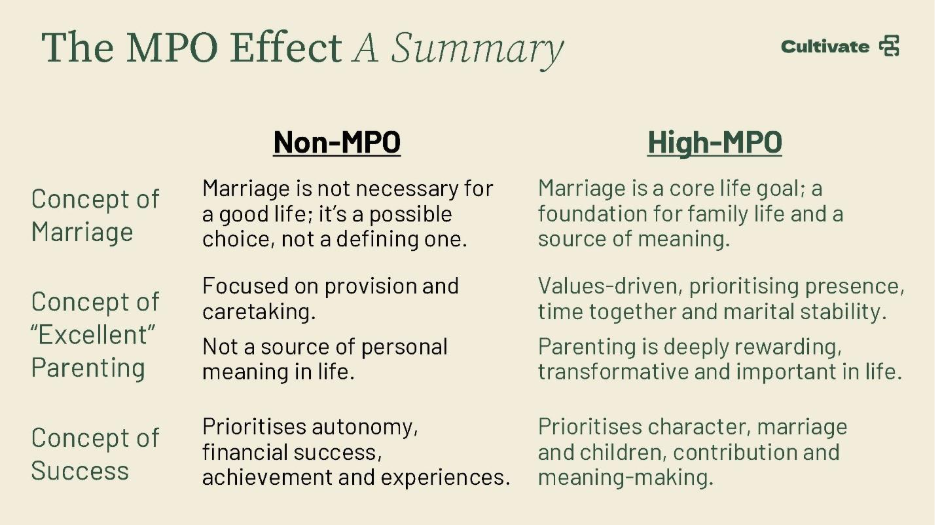
All in all, if we look at this across whatever I’ve said; Non-MPO and High-MPO, these categories are more than just categories. They seem to frame how one understands marriage, parenthood and success in life.
So, to the High-MPO, marriage is really not just an optional thing to them, it’s a core life goal, it’s an institution and a foundation for family life and even a source of meaning, and parenting to them is deeply rewarding.
So even though there are the same kind of difficulties that we might face as a parent, they are less deterred in terms of wanting to have more kids or wanting to have kids.
And they also tend to prioritise character, marriage and children in terms of what makes a successful life. So to them, these are integral parts of what makes a beautiful life for them, their form of Singaporean Dream.
And what does all this mean to us?
I think that, or we if we look at all this, in total, we realise and we can see that the various financial support from the government offered to help parents and large families have been helpful, especially since the top three concerns that affect a person’s or caused someone to delay, or discourage some someone from being a parent seem to be finance-related.
But they seem to only help those who already desire having a larger family or want marriage and parenthood in the first place.
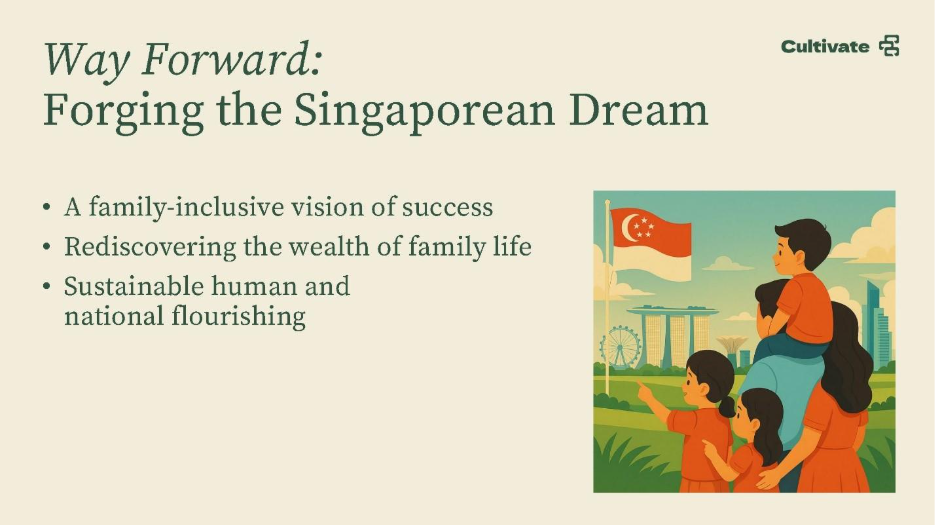
So, to see a greater impact or to be more effective in lifting our total fertility rate, we must have a family-inclusive vision of success. And I don’t say this in terms of a utilitarian approach to wanting to create this more holistic view of success, because we do need to rediscover the wealth of family life.
So it could look a bit like acknowledging the fact that being a parent is going to make our lives a lot more chaotic, make us a lot more busy, and sometimes, it might also make us feel like we are losing a part of ourselves.
But this loss can be in a positive and transformative way; I myself can attest to that.
So perhaps with such a view, a more High-MPO-oriented one, we can better attain sustainable human flourishing and national flourishing, and that will take us from where we are today to SG100 and beyond.