Conceptually, there is no one definition of a “sandwiched” family, ranging from those who live together or nearby, to different kinds of support or care provided to young and old. A reasonable estimate suggests there are more than 100,000 sandwiched households in Singapore. Perhaps valuing and supporting people in their caregiving journeys may be a more constructive way forward.
“Families today are smaller than before, with more sandwiched couples having to care for both the young and old,” warned Minister Indranee Rajah in 2024.
She was talking about the impact of the falling total fertility rate (TFR) in Singapore, which hit lows of 0.97 in both 2023 and 2024. In 2025, it hit a new record low of 0.87, far below the replacement rate of 2.1.
But what exactly makes a couple or family “sandwiched”?
Unfortunately, there is no one definition.
Are There Too Many Ways to Make a “Sandwich”?
A 2018 study by Tan Poh Lin published in the Journal of Aging found three different definitions of what it means to be “sandwiched”. These are:
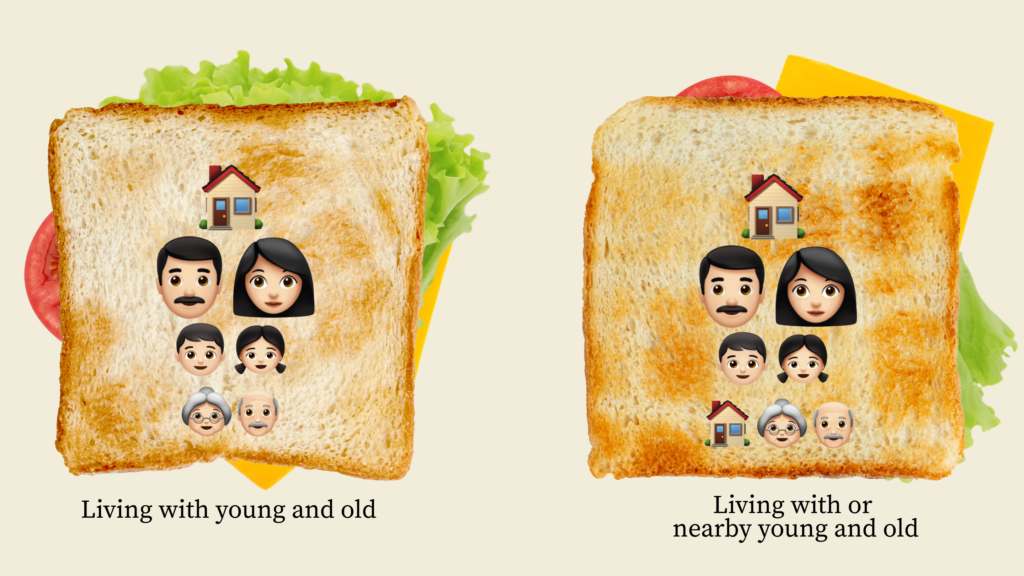
- Living together with young and old. Couples co-residing with at least one elderly parent and at least one child.
- Living together with or nearby to young and old. Couples who co-reside or who reside within 15 minutes’ walk to the residence of at least one elderly parent and at least one child.
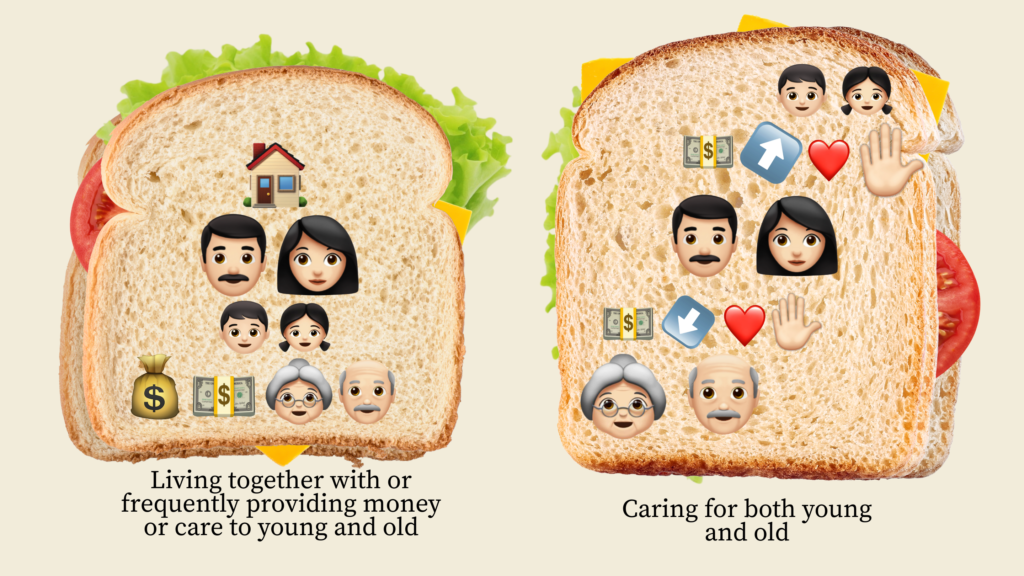
- Living together with or frequently providing money or care to young and old. Couples who co-reside or very frequently or frequently provide transfers of money or physical care to at least one elderly parent and at least one child. Such physical care included things like household chores or childcare or healthcare for parents.
Another possible definition of being “sandwiched” is based on caregiving, which was given by Ang Bee Lian, the Director of Social Welfare at the Ministry of Social and Family Development (MSF). In a 2015 letter to students of social work, she described the “sandwiched generation” as “the layer of people who are caring for both children and parents at the same time”. This seems to be the definition adopted by Minster Indranee Rajah too, in the quote at the start of this article.
Are there too many ways to make a “sandwich”?
In the study by Tan, the different definitions yielded different proportions of sandwiched couples across China, Japan, South Korea and Taiwan. Taiwan had the highest percentages of sandwiched couples under the first (24.33%) and third (53.67%) definitions.
China had the highest proportions under the second definition (49.9%). The study suggested that living nearby may be more common in China due to lower levels of urbanisation in some areas, traditional preferences, lack of formal childcare services, and higher levels of dependency by less educated elderly.
Different Degrees of Care
Virtually all studies on sandwiched families recognise increased challenges and caregiving burdens that they experience, due to the need to care for young and old.
As Tan found in her 2018 study, married women (as compared to men) in those East Asian societies were the ones who felt the strain of being sandwiched with “dual burdens of care”, having lower life and marital satisfaction. This is because of “gender imbalance in the assignment of care obligations, which fall more exclusively on the shoulders of women”.
Another study in Hong Kong found a range of pressures such as time management issues, physical exhaustion, stress, and caregiver burnout.
Nevertheless, one common problem with all definitions of “sandwiched” couples seen above, is that they do not consider different degrees of care provided to the young, old or both.
Consider a case where three generations of a family are staying together with two wheelchair-bound grandparents, a single-income couple and two young children in preschool.
Contrast this with another hypothetical household with two healthy retired grandparents, dual-income parents and a child in primary school.
Both fit within all three definitions of being “sandwiched”, even though their needs are very different and the grandparents may even be able to help with childcare in the latter case.
How Many “Sandwiched” Families in Singapore?
Due to the problems defining the term “sandwiched” family, it is difficult to estimate exactly how many “sandwiched” families there are in Singapore.
One possible estimate – based on a 2022 paper published by the MSF – is that there may be at least 100,000 households who are “sandwiched” under the first definition, where couples co-reside with at least one elderly parent and at least one child.
In 2020, out of 472,800 households with at least one member aged 65 years and above, around 22.5% (i.e. around 106,380) were households with three or more generations (referred to as “3G Households”), the study found.
However, this estimate should be taken with a pinch of salt, because a “3G Household” could also include a household where there are three or more generations living together, all of whom are aged 18 or above. The middle generation may not necessarily include couples either.
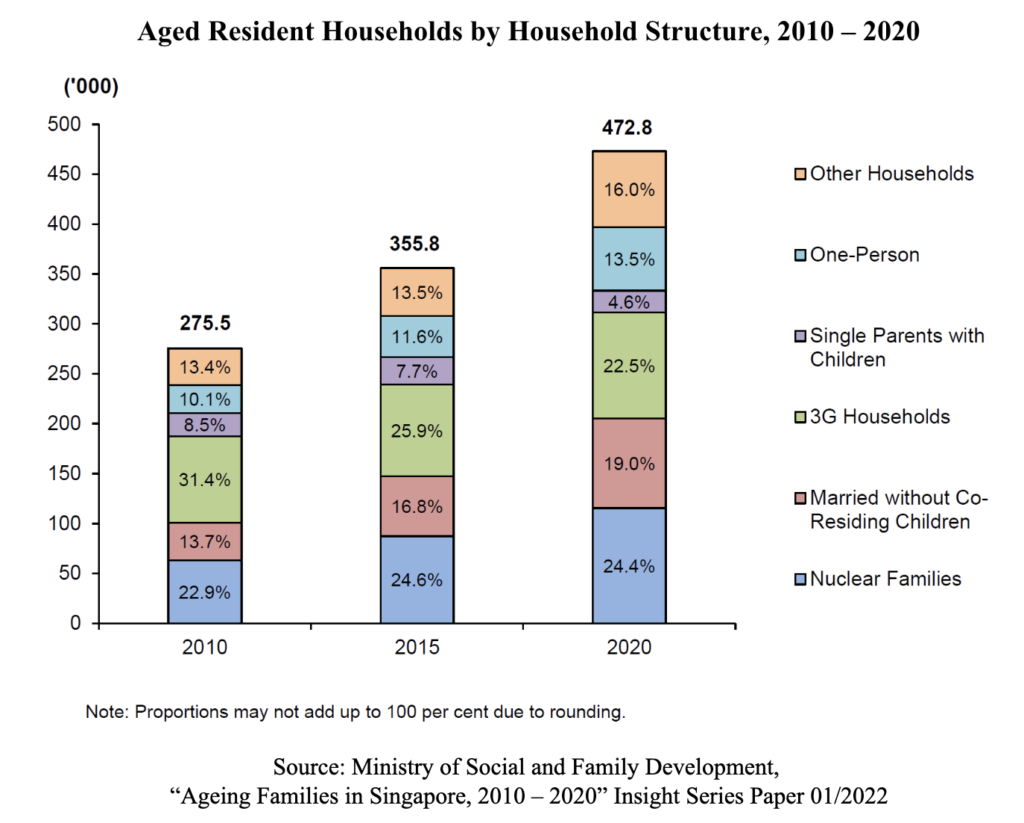
Yet a simple estimate like this will not give an accurate picture either, as an increasing number of elderly may prefer not to live with their adult children when they become dependent.
Indeed, the same MSF study found that nearly half (46.2%) of elderly persons said they preferred to live in their own home with caregiving by family or domestic help, if assistance with daily living was required. On the other hand, only around one in four (25.5%) said that moving in with children would be ideal.
The trend may instead towards Singaporeans living near instead of with their elderly parents, while maintaining frequent exchanges of support. This is further incentivised under the Housing Development Board’s (HDB) Proximity Housing Grant (PHG) scheme, where home buyers can get a grant of $20,000 to live near (within 4km) their parents or children. Between 2020 and 2023, around 44,700 households benefited from the PHG.
With these trends, the actual number of “sandwiched” families in Singapore may possibly be much higher.
Valuing and Supporting Caregiving
Without a clear definition and understanding of the number of “sandwiched” families, how can their needs be addressed?
In our view, perhaps the most constructive way forward is to value and support people in their caregiving journeys, whether caring for young, old, disabled or others.
First and foremost, caregiving should be valued as an important part of human flourishing, as Associate Professor (Dr.) Tan Seow Hon pointed out at our “Unfiltered” conference last year. It is formative of character and a path to self-actualisation through love and self-giving.
This is a contrast to the prevailing attitude within Singapore society, which tends to value material and career success.
Next, from a societal and policy perspective, it would help to focus on specific types of support for various caregiving needs.
One current scheme is the Home Caregiving Grant (HCG) which provides monthly cash payouts of up to $400 to help families caring for persons with moderate to severe disabilities, to locals whose monthly household income per person is $3,600 or less. In April 2026, this will be enhanced to $600 a month, and the qualifying income level will increase to $4,800.
It may be worthwhile to expand on other forms of caregiving support, including through grants and tax reliefs.
There may also be room for a specific support for “sandwiched” families, especially those from lower-income groups, who are providing care to both young and old.