Singapore is at a turning point.
This year, our society enters “super aged” status, with at least 21% of our population aged 65 years and above.
At the same time, our birth rates have been falling, with our total fertility rate (TFR) hitting an all-time low of 0.87 in 2025. This has prompted the Government to launch a “reset” on marriage and parenthood by establishing a Workgroup to spearhead these efforts.
The Government is also taking numerous steps in light of our rapidly ageing population, such as building new hospitals and polyclinics, and growing the healthcare workforce.
Caregiving in Singapore: A Snapshot
Much of caregiving is often private and invisible to the public eye, taking place within the family context. This is consistent with our social norms, since most Singaporeans believe that it is their responsibility to care for their family members, and would look to their family members as a first stop of support in times of need.
This is often referred to as “informal” caregiving, as opposed to paid caregiving such as domestic helpers or childcare and eldercare institutions.
What does such caregiving look like at the moment?
In 2025, 72,500 Singapore residents (or 6%) were outside the labour force mainly for caregiving reasons. Of this number, the largest group were stay-at-home parents taking care of their own children (40,400, or 56%), followed by adult children looking after their parents (12,300, or 17%).
As Singaporeans are marrying and having children later, an increasing number of couples find themselves “sandwiched” in their caregiving responsibilities. Preliminary results of a 2025 survey conducted by the Ministry of Manpower (MOM) found that around one in 10 workers concurrently care for children and parents; this means that there are around 240,000 locals who are balancing work and caregiving for both young and old at the same time.
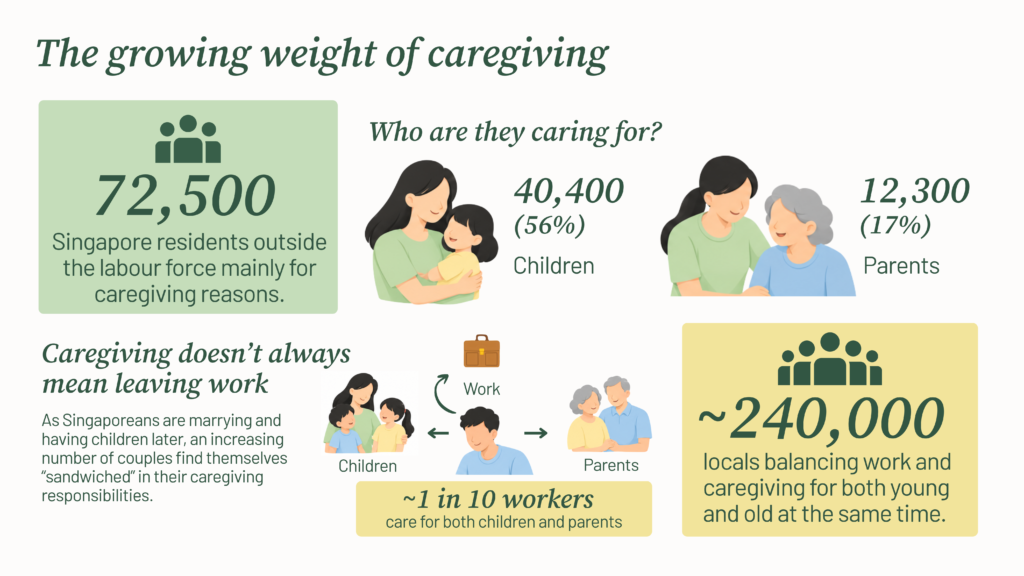
We have not been able to find data on those outside the workforce who are simultaneously taking care of young and old, but we can expect the number to be substantial and growing in years to come.
More Women than Men in Informal Caregiving
In our local context, informal caregiving is very often provided by women, although men are also involved.
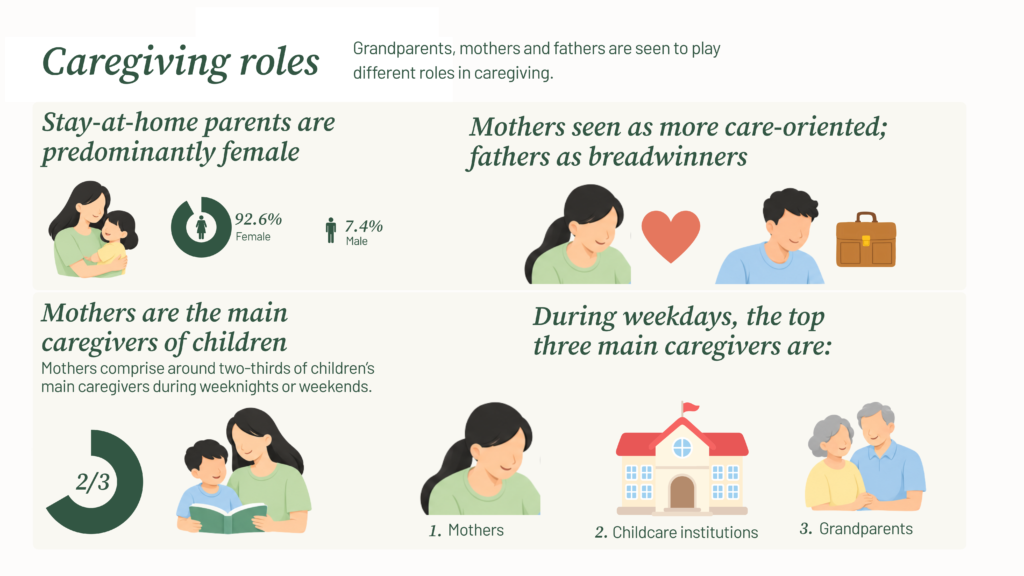
Stay-at-home parents are predominantly female (92.6%), according to 2025 MOM statistics.
Likewise, our 2024 Parenthood and Work Survey found that Singaporeans generally regard the role of mothers as being more care-oriented, as compared to fathers who were largely seen as breadwinners.
This perception manifested in practice, with mothers comprising around two-thirds of main caregivers of children during weeknights and weekends. During weekdays, the top three main caregivers were mothers, childcare institutions and grandparents.
Similarly, grandmothers are much more involved than grandfathers in providing care for their grandchildren, as a 2019 Singapore Children’s Society study found. The authors described this as the “gendered division of labour”, with “women undertaking traditional caregiving roles to a greater extent than is commensurate with their current levels of education and employment”.
Among adults who are taking care of their parents full-time, MOM found that women are more likely to be doing so (59.9%), although there were a sizeable number of males too (40.1%).
More Care Will Be Needed in Time
As Singapore’s population increasingly ages, the demand for caregiving will foreseeably increase. More elderly are expected to need help with activities necessary for basic independent self-care, such as washing and feeding oneself. In the healthcare context, these are referred to as basic “Activities of Daily Living” (ADLs).
The Government projects that, by 2030, around 100,000 Singaporeans aged 65 and above will have at least one ADL limitation requiring human assistance.
An even greater number may be expected to need help with “Instrumental ADLs” (IADLs), which are more complex activities that require higher cognitive functions and are related to the ability to live independently, such as communicating with others and managing one’s finances.
Another study predicts that, by 2050, one in six locals aged 55 and above will have at least one ADL disability, and one-third of locals aged 55 and above will have at least one IADL disability.
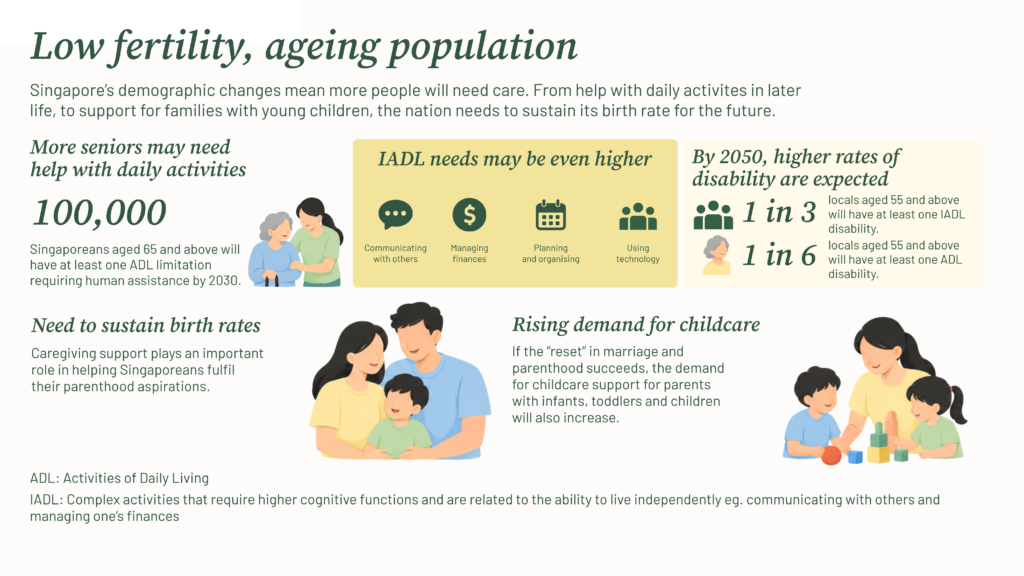
At the same time, Singapore society will need to improve its birth rates to sustain itself. As alluded to in the National Day Rally 2026, caregiving support plays an important role in helping Singaporeans fulfil their parenthood aspirations.
If the “reset” in marriage and parenthood succeeds, it is foreseeable that the demands for childcare support for parents with infants, toddlers and children will also increase.
These demands and pressures may be particularly significant for the growing number of “sandwiched couples” who have to care for young and old.
Government Policies: Expanding Institutional Care, Encouraging Self-reliance
With growing caregiving needs, the Government is adopting different strategies for young and old.
For the young, the aim is to expand affordability, accessibility and quality of infant care and childcare. At the recent National Day Rally, Prime Minister Lawrence Wong announced plans to reduce full-day childcare fees to $150 a month and infant care fees to $300 a month for every Singaporean child, regardless of household income. There have also been efforts to increase the number of preschools in every neighbourhood, and invest in upskilling and organisational capabilities in the preschool sector.
The strategy is slightly different for seniors, where the emphasis is on encouraging seniors to remain healthy and socially connected, and to contribute meaningfully to society for as long as possible. Under the latest Action Plan for Successful Ageing, the Government aims to empower seniors to take charge of their physical and mental well-being through preventive health, active ageing programmes and care services.
At the same time, the Government is spending more on healthcare to support our ageing population, with ongoing developments of more hospitals, polyclinics and nursing homes, and more caregiving services being rolled out. Healthcare spending is projected to increase from $22.5 billion this year to about $30 billion in 2030.
A Change of Perspective
Even as caregiving needs in society are growing and the amount of government support are rising, a deeper shift is needed: A change of mindset.
Instead of thinking of caregiving from the lens of “efficiency”, we need to think of caregiving as something worthwhile and an act of love. As Associate Professor (Dr) Tan Seow Hon emphasised at our “Unfiltered” conference last year, caregiving is “formative of our character, developing something good, and it’s actually a way of self-actualisation”.
At its core, showing love and care for one’s parents or children is not about providing a commercial service, but about relationships. This perspective was strongly emphasised at our Commune on sandwiched families in May this year, where mother of three Xue Ting shared about how it was a privilege to be able to love her mother with Alzheimer’s and to be reminded about the “value of life” as she raises her three children.
Caregiving cannot be reduced to a mere service that can be commodified and paid for, Anne Manne writes in Love and Money: The Family and the Free Market. It is fundamentally a labour of love, an intimate human relationship which cannot be reproduced through the means of the free market.