People are wondering, “Why is there such a mental health crisis across the world? It’s not just a Singapore issue.”
In The Anxious Generation (2024), Jonathan Haidt looked at the Gen Zs, people who are born 1995 and later. That would mean they are currently about 31 years-old or younger.
Something went wrong in the early 2010s with the mental health crisis among the Gen Zs, but not so much among the older generation. This begs the question: Why is it the Gen Zs and not everyone else?
Haidt found this thing which he coined “The Great Rewiring”.
The Great Rewiring
Essentially, we moved from a play-based childhood to a phone-based childhood. And he hypothesises that this is causing a lot of rewiring in the brain, leading to children not developing the executive functions that would help them to make decisions, make plans and execute those plans. Therefore, tiding over some of the adjustments into adulthood or dealing with these issues in adulthood.
That is one of the biggest drivers, he believes, in this mental health crisis that we are looking at today.
There is a kind of increase when it comes to mental health crisis for Gen Z, shaped like a hockey stick on a graph.
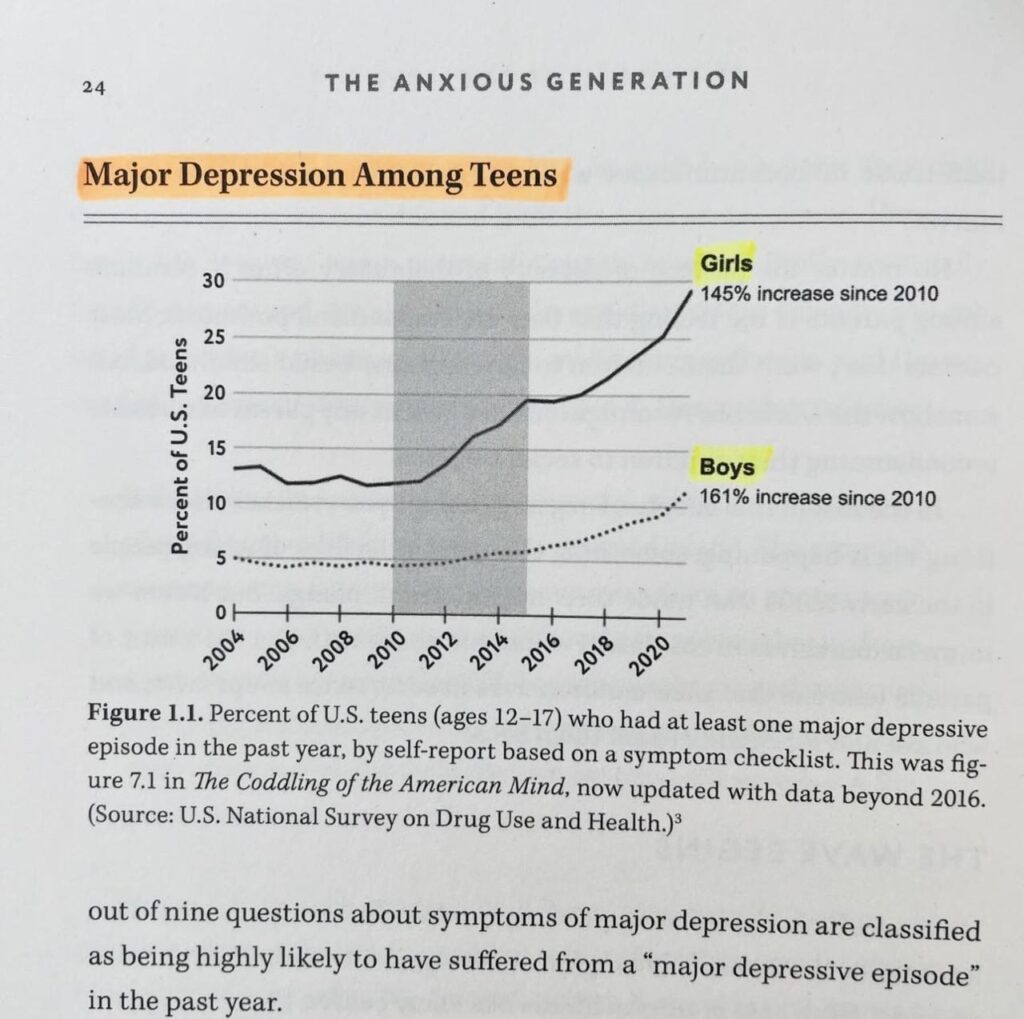
He attributes this increase to the invention of the iPhone and proliferation of all the visual social media apps.
When the front facing camera came to market, that really changed the game. Social media prior to that involved a lot of text-based connection. Even though there was the internet, the first wave of growth through the internet did not create the same level of mental health issues among the people who grew up with that internet.
But when it came to this phase – the second wave, he calls it – when the front facing camera and the visual-based social media hit the market, the young ladies were the ones that showed the worst reaction to this development.
Biggest Victims? The Young Girls
All across the world – especially the richer ones and those with high internet connectivity – they have observed this sharp increase in mental health crisis, especially amongst young girls.
It is not that the young boys are immune to this. The data shows that they are also similarly affected, but in slightly different ways.
The reason why there is this increase in anxiety and depression is really because young people today live very differently from young people twenty years ago, because at the age of 13 or even 16, a lot of them have their own smartphones and social media accounts.
What happens is that they become their very own brand manager. They have to look at the way they post things. They have to constantly check their notifications. Every time there’s a pop up, they will look at it because this is driving a certain dopamine production in their brain, and consumption of it.
And they also want to know what’s the latest news among their friends, because social bonding is very important developmental at that age, 13 to 16 years old.
Now that is the phase where they are going through puberty. There are a lot of things going on physically and psychologically as well. And that is why it affects the youngsters so much. Haidt mentioned Gen Z, because this was the generation that had puberty through this period.
From The Playgrounds to the Phones
And the generation after Gen Z is right now growing up in a phone-based childhood. They are literally not playing with toys, and not going out to playgrounds anymore. Now, there’s a lot of overprotection in those senses. Parents are very concerned about children breaking their bones, falling down, getting a cut, and things like this. And so sometimes, they prefer to just keep their children at home, to use phones and to stay safe at home.
That kind of overprotection in the real world has led to other consequences, such as a rewiring of their brain or perhaps exposing them to new kinds of risks online because there seems to be an under-protection in the virtual world. For example, if you are a girl, you are opening up yourself to sexual predators online because anyone can write to your DMs (direct messages); it’s a pretty easy thing to do.
This is why policymakers around the world are trying very hard right now to figure out a reasonable solution to deal with all of these things. Some countries have opted to ban social media for children altogether. Singapore does not look like it is going that direction for now, but is looking at other solutions in a similar fashion.
This is why there is this base level of anxiety, which can lead to depression, because they are always consistently thinking about what’s going to happen. They are trying to anticipate what’s going to happen to their next post or the last post they posted ten minutes ago. This lingers on their mind. It takes their mind away from things that are right in front of them, and that is why it impairs their development of their executive functions.
They are not able to focus anymore. And this is one of the foundational harms that Haidt mentioned in the book that is the result of this Great Rewiring. Sleep deprivation is something that has to do with the choices that young people are beginning to make. In fact, even adults can be sleep-deprived because of the use of social media.
That is something that we may not even notice because it is just so addictive. It is so easy to scroll, there are so many auto-plays, and sometimes they are just interesting things that you read that you want to fact-check or you just want to follow up on. These are the kinds of things that lead to poor choices, especially for teenagers who are very emotionally driven at this age.
Social media is meant to drive that kind of a hook that giving them emotional or extreme kind of content, and those are the ones that garner the most eyeballs. Naturally, if you see something shocking you will share it with people, you are likely to comment on it; so eventually it is just the natural result of that kind of a system.
It rewards more extreme, more shocking content. That is why people eventually get hooked on it and people make choices. We only have 24 hours a day, right? So if you want to be online for two hours, four hours a day, guess where these hours are going to come from? It is either sleep, your studies, your work, or your social circles.
We are also witnessing that in schools, even though at break times the students are physically together, they are not actually talking to each other face-to-face. It is a little bit like the movie Wall-E.
In that movie, everyone is on this comfortable chair floating around, being driven away by artificial intelligence (AI). They are not even aware of the person next to them. They are talking to each other through these virtual screens like Zoom, but they were never aware that there was someone beside them.
Now, that is the kind of a picture that this book is also trying to paint. It is the reality that people are in proximity, but they are no longer speaking to each other.
They would rather play a game together online, or they would rather just share some videos and look at it together. The kind of community bonding and social interactions have changed significantly, and that has led to a certain increase of loneliness and the inability to empathise with people, the inability to exchange ideas and to be able to deal with offences as well.
All these things are part of the first two harms.
The first is attention fragmentation. Basically, they are starting to be sucked into this constant stream of distractions, and so they are not able to focus on the task at hand.
In the past, when we read physical books, we had to finish the whole book. Or rather, one is stuck on a single track of thinking that you want to finish the book, you want to finish that thought.
But today on social media, everything is in seconds. Sometimes, even if you say “I’m reading a book online”, there are so many hyperlinks in your books that so it is very easy to say, “Hey, this is interesting, let me check it out.” And then you just go down a rabbit hole.
Your attention is fragmented. If you keep a phone in your pocket and you constantly want to think about what is happening online now, that is again a type of attention fragmentation. You are no longer focusing on the task at hand. You are constantly thinking about something else. These are actually damaging the cognitive development and also performance.
Lastly, there is the harm of addiction. This again manifests quite differently for boys and girls. Broadly speaking, boys are addicted to a different kind of thing and rewarded for a different kind of activity (e.g. gaming or pornography), whereas girls are usually feeling rewarded for perfectionism or attention.
Not every boy and girl is going to be like that. But on the general trend, that is what you see, which is why the disorders are also manifesting quite differently.
You will see here in our local study launched in 2022, they published the data in 2025.
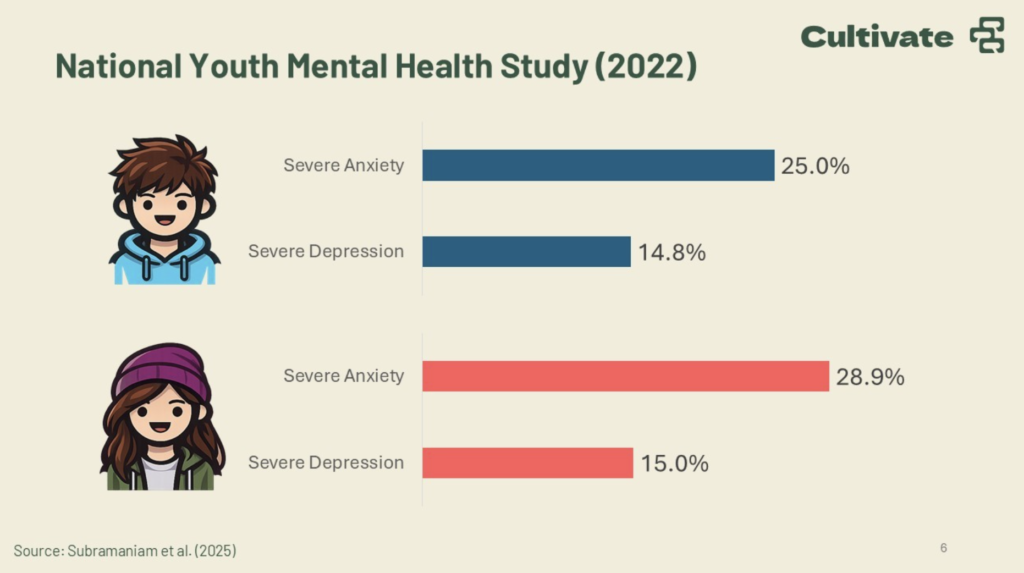
But this is a snippet of it. For boys and girls, the anxiety levels are pretty high. It goes slightly higher than the boys. And this is severe or extremely severe levels of anxiety self-reported by the youths. And the severe depression levels are also quite high, but you see a slightly more elevated figure for girls.
A Generation Transformed
The truth is that parenthood also transforms the parent to be someone who is less anxious of things, because you learn to let go of things you know you cannot control. That trains your character as an adult, and that also gives you an opportunity to train the younger generation to be able to do that, because as a generation lives, the next generation learns and they will have to be able to carry on the society in the future.