“I’ve been hosted in homes of these women, and I find that they’re very generous despite the lack of resources,” said Mums for Life co-founder Ms Fannie Lim, reflecting on her experiences with lower-income stay-at-home mothers (SAHMs) and their generosity.
At our “Unfiltered – The Family on Trial” conference last year, Ms Lim spoke about her “dilemma” with these families: Should she encourage them to go out to work and thus move up the socio-economic ladder, or encourage and give them the space to prioritise raising their children, who benefit from parental guidance?
Whether by choice or circumstance (such as cost-of-living pressures), more women are going out to work, with the result that SAHMs are becoming increasingly rare in Singapore.
Since 2020, a majority of Singaporean married couples are dual career couples, meaning that husband and wife are both working. Singapore has a high female labour force participation rate of 80.5% among women aged 25 to 64, not too far behind Estonia, the country with the highest rates (88.5%).
As SAHMs become increasingly rarer, we know what we’re gaining, but are there any trade-offs?
Drop in Number of Stay-At-Home Mothers
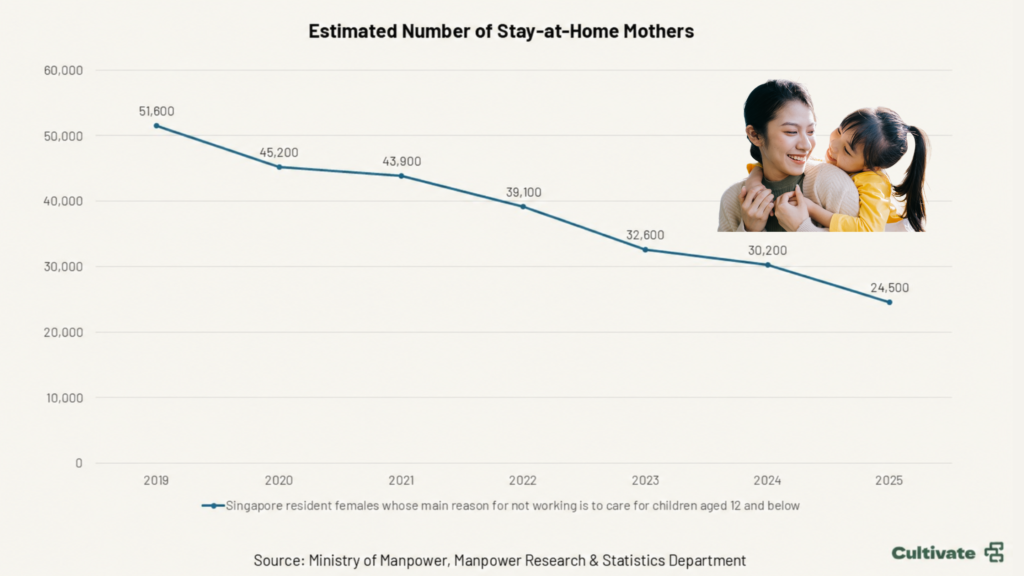
There are no official statistics on the number of SAHMs, due to a lack of an accepted definition of what constitutes an SAHM. However, one useful proxy – used by the Ministry of Manpower (MOM) – is the number of women whose main reason for not working is to take care of children aged 12 and below.
This number has more than halved over the last seven years. Based on MOM statistics, their number has fallen from 51,600 in 2019 to 24,500 in 2025.
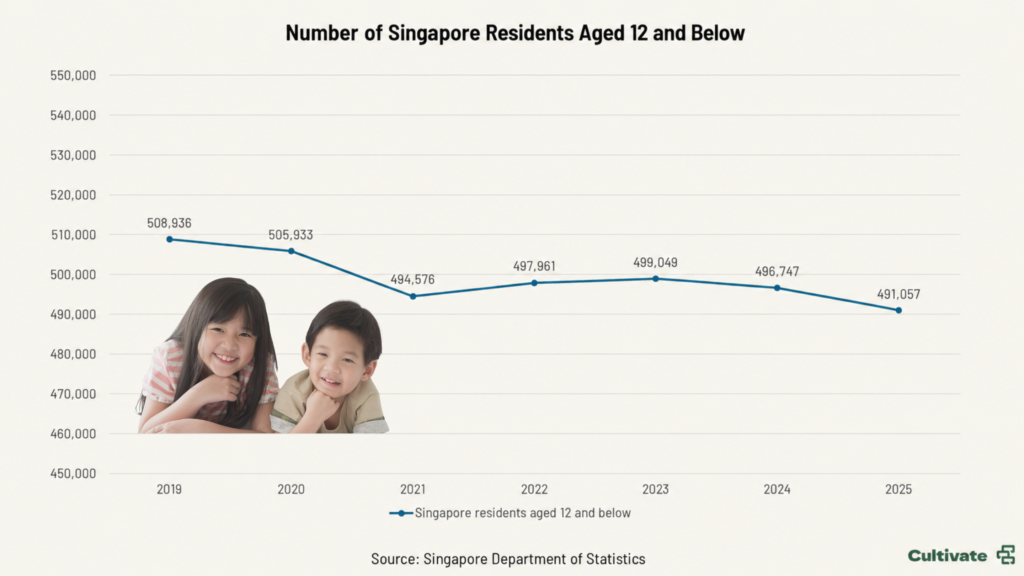
This is not exactly due to Singapore’s low birth rates either. While Singapore has been struggling with falling fertility rates for decades, the number of local children aged 12 and below has not fallen as drastically as the number of SAHMs.
Within that same period, the number of local children in this age range decreased by only approximately 3% (or 17,000), from 508,936 in 2019 to 491,057 in 2025.
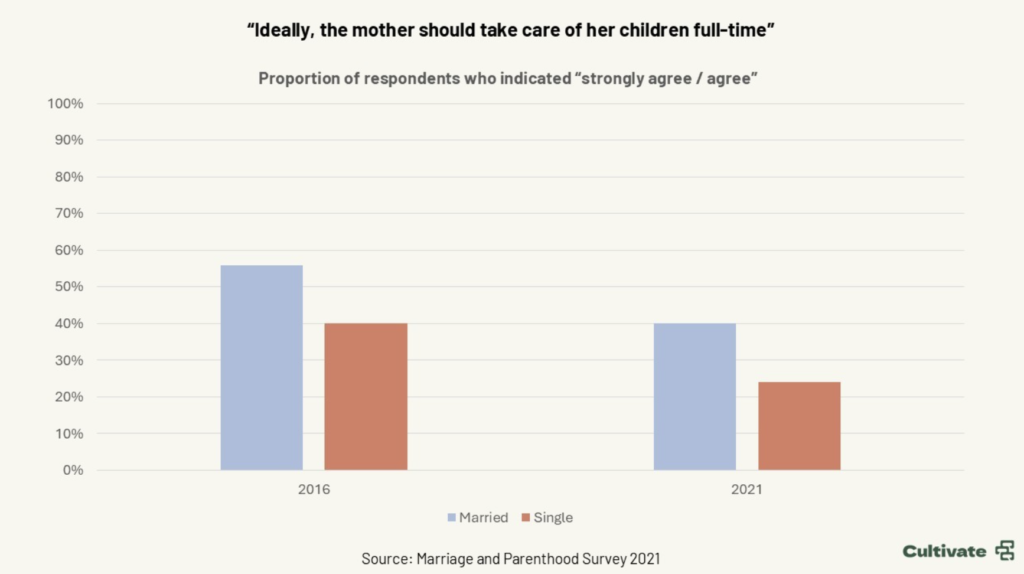
These societal realities may not exactly reflect the ideals held by everyone here. As the 2021 Marriage and Parenthood Survey shows, two in five (40%) of married respondents thought it would be ideal for mothers to take care of their children full-time.
Gains…
This trend benefits the economy, increasing the larger pool of workers.
The labour force participation rate among female residents aged 25 to 64 years has risen from slightly more than half (56.7%) in the year 2000, to around 8 in 10 (80.5%) in the year 2025.
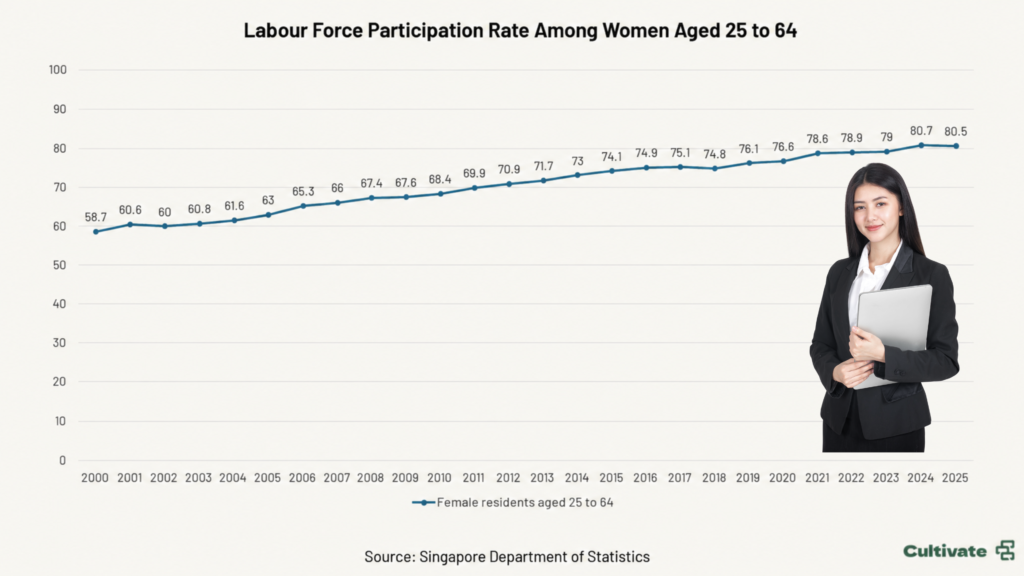
Work allows for upward mobility, where individuals and families rise up the socio-economic ladder and improve their standard of living. The overall stronger economic growth brings positive knock-on effects such as a higher quality of life in terms of material success. In turn, Singapore ranks among the top ten in terms of gross domestic product (GDP) per capita. Singapore was even named the richest country in the world, when comparing GDP per capita to purchasing power.
Another related upside is that of women’s equality and empowerment. The right of women to participate in economic life on equal terms is guaranteed under the Convention on the Elimination of All Forms of Discrimination against Women (CEDAW), an international human rights treaty to which Singapore is a party.
Article 11 of CEDAW requires States Parties to ensure that women have the same rights as men in the context of employment, including freedom of choice of profession and employment, and the rising number of women participating in the workforce may suggest that important progress is being made.
And Gaps...
Yet, there are new gaps in society with less SAHMs.
Many SAHMs choose to do so because they prioritise caring for their children, especially during the earlier years of childhood; this benefits their children. A 2023 Frontiers in Psychology study of families in China found that children’s well-being increased, the more their parents spent time with them. Conversely, a 2025 Japanese study found that insufficient mother-infant bonding may contribute to asocial behaviour in young boys.
Mothers who dedicate time and energy to have and raise their children contribute to their lives and to society in the long-term.
(To be clear, involved fathers also benefit children, as noted in a 2009 research booklet “The Difference a Dad Makes – What Does International Research Say?” published by the then-Ministry of Community Development, Youth and Sports.)
Another important contribution comes from a particular subset of SAHMs, namely, those with large families. In a 2014 article titled “Stay-home mums productive too”, Angela Shanahan argued that SAHMs who have large families (three or more children) should be seen as are “economic drivers of the future” by helping to ensure fertility at replacement levels. They contribute positively to the health, education, moral and social development of their children.
And there’s more. SAHMs contribute meaningfully to their neighbours, friends and community through their altruism and generosity too. This includes simple acts like inviting others over for meals, helping to watch their children, and volunteering in community initiatives. These generate social capital, which is the value from positive connections between people.
Minding The Gap
With the decline in the number of SAHMs, there are both gains and gaps.
We need to ask: What do mothers, their children and their families really need and want?
For our “super-aged” society whose total fertility rate (TFR) hit a new record-low of 0.87 in 2025, far below replacement levels of 2.1, our future economic growth is now threatened by demographic changes. With a population projected to shrink by the 2040s, it is clear that the gaps will only grow.
We need to have more flexible understanding of career paths. Women (and men) should not be faced with a binary option of either working full-time or not working at all. Parents shouldn’t feel like they are driven to work long hours, with no choice but to sacrifice family life. There should be real choices that people can make to suit their current stage in life.
For example, there is room to expand the part-time job market to accommodate the preferences and needs of women who have caregiving responsibilities. The MOM “Labour Force in Singapore 2025” report found that female part-time employment rate here (5.9%, compared to the OECD average of 13.7%) is among the lowest compared to OECD countries.
MOM also noted that, among those who are employed, married women with children are more likely to be in part-time employment compared to single women or married women without children. Married women outside the labour force also expressed a preference for part-time employment.
Another much-needed societal change is to better value caregiving. Only a small majority of Singaporeans (56%) agree that men and women who stay home to take care of children or elderly needs are recognised for the value they bring to society, a 2021 Ipsos survey found.
As a society, we should acknowledge and celebrate the numerous unseen and unheard efforts that caregivers are providing to their loved ones and beyond.