In a largely traditional Asian society like Singapore, family remains the key source of support for many. A 2023 government survey found that most people (83.3%) ranked family members among the top three choices in meeting the needs of the elderly.
Studies show that strong marriages also benefit the elderly. Unfortunately, the reverse is also true. Never married or divorced elderly persons are potentially the most vulnerable (especially men).
Who Gives and Receives the Least Support?
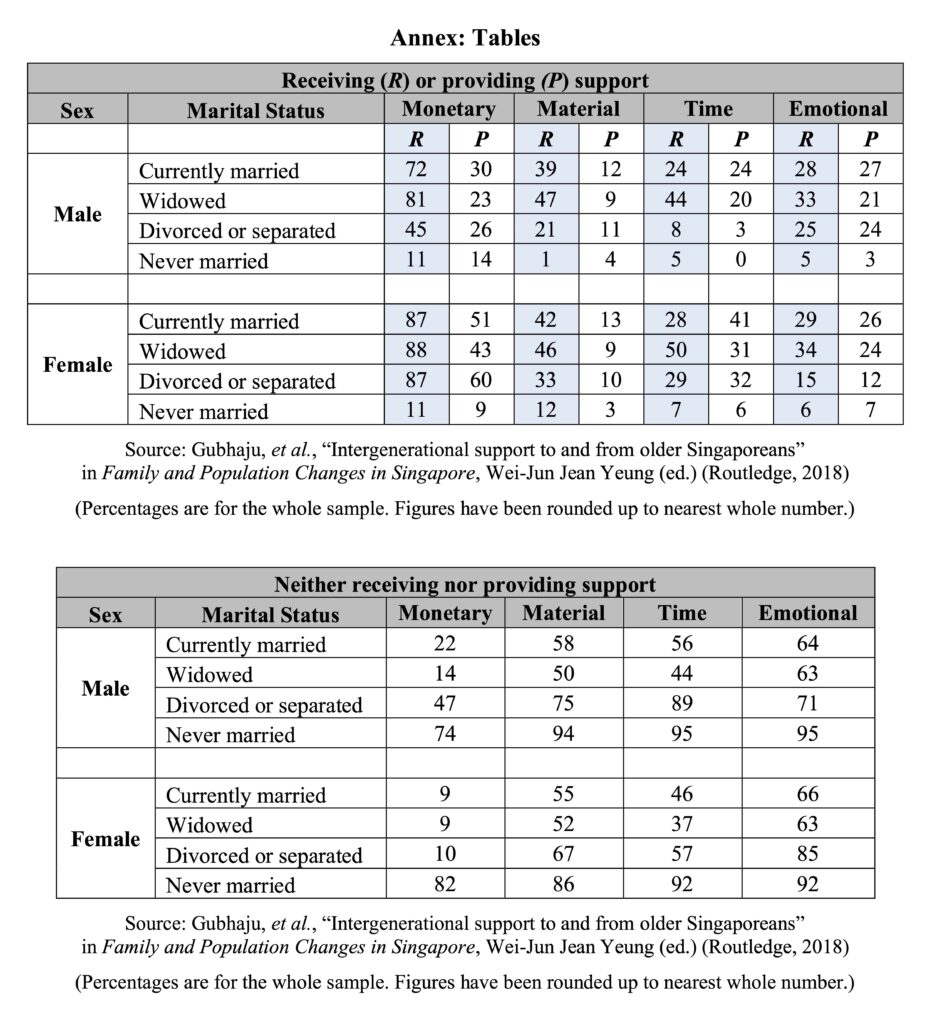
Single elderly persons who are never married or who are divorced tend to receive and provide the least amounts of monetary, material, time and emotional support to family members.
This was found in a study titled, “Intergenerational support to and from older Singaporeans” published in a 2018 book Family and Population Changes in Singapore.
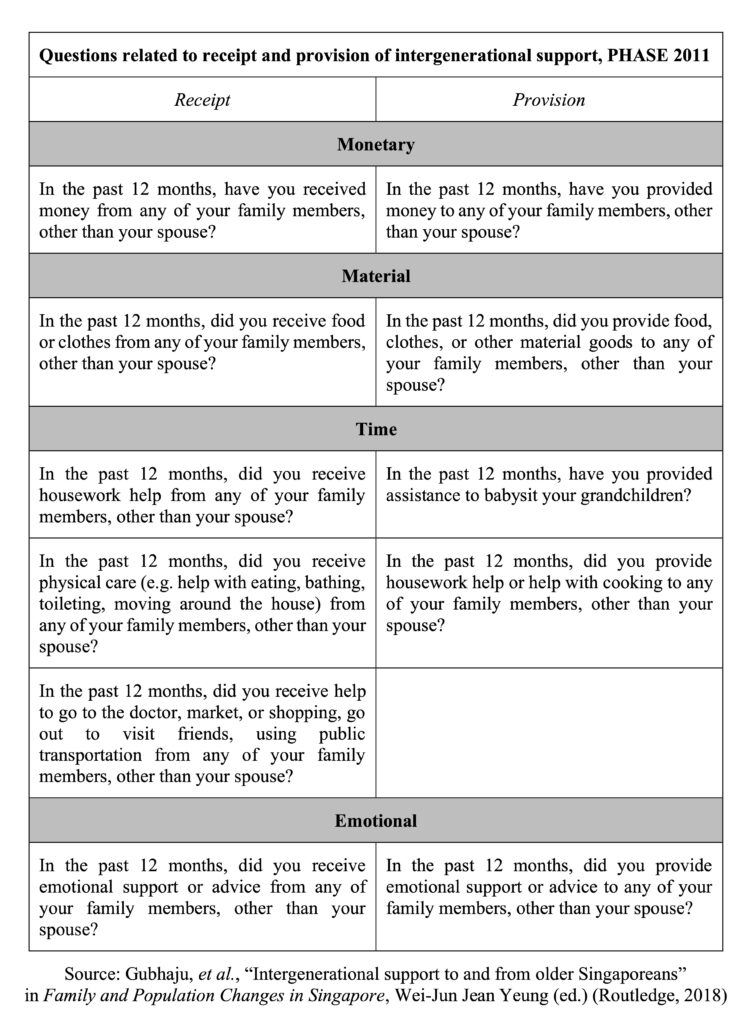
Drawing from the 2011 Panel on Health and Ageing of Singaporean Elderly (PHASE), a comprehensive source of data on intergenerational support, the researchers analysed the types of support received and provided based on different characteristics of older Singaporeans. The study defined the “elderly” as those aged 62 years and above.
Gubhaju and colleagues found that elderly are generally recipients of monetary support, with more than three in four (76%) receiving monetary support from their family. Around half that number (37%) also provide money to subsequent generations.
Generally, elderly women are more likely than elderly men to receive monetary support.
However, there are big differences in terms of all kinds support received or provided depending on marital status, especially for men. Never-married elderly received and provided the least amounts of all kinds of support, followed by elderly men who were divorced or separated.
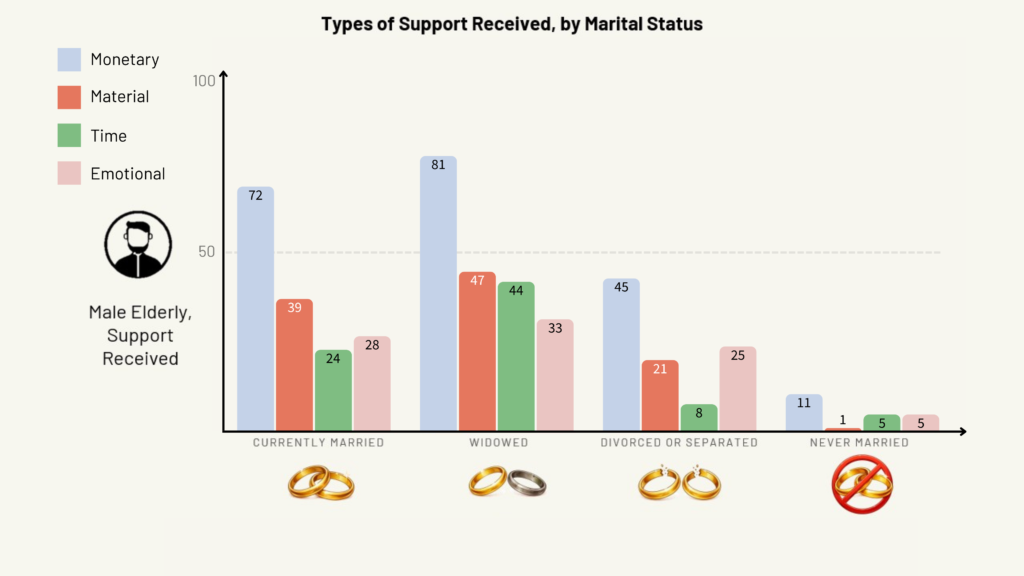
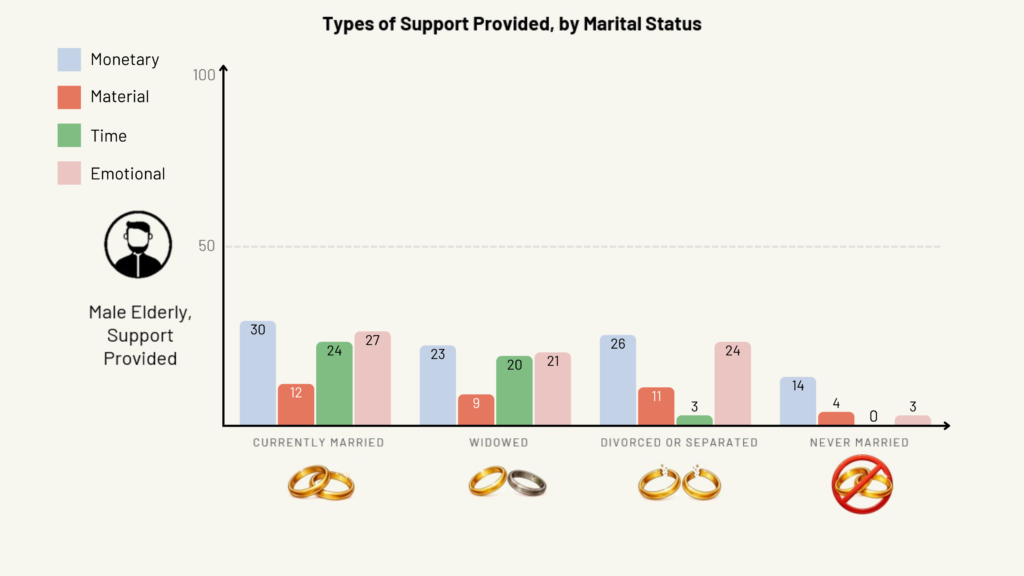
On the other hand, divorced or separated elderly women still received and provided fairly high levels of monetary and time support, somewhat comparable to their married peers.
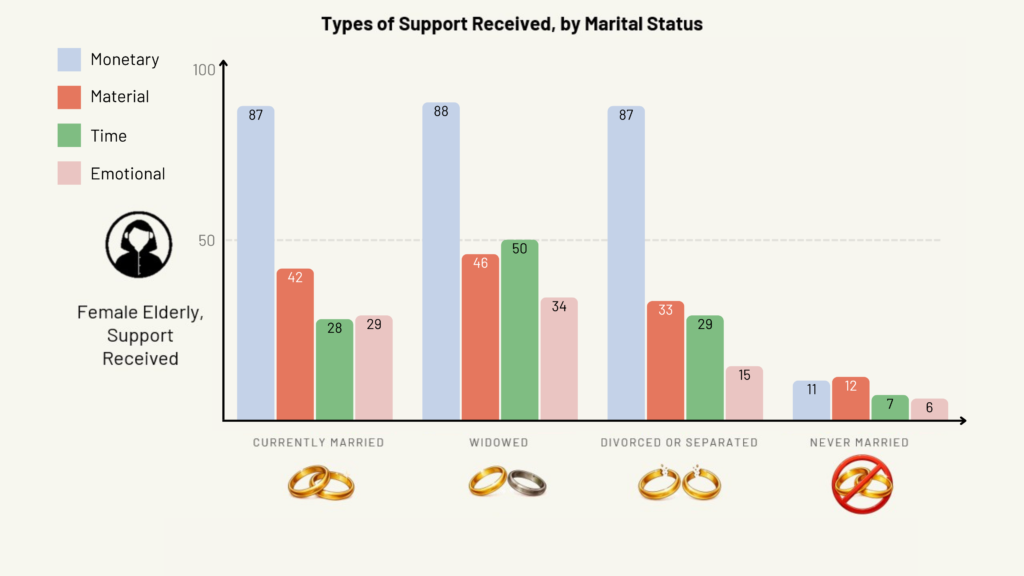
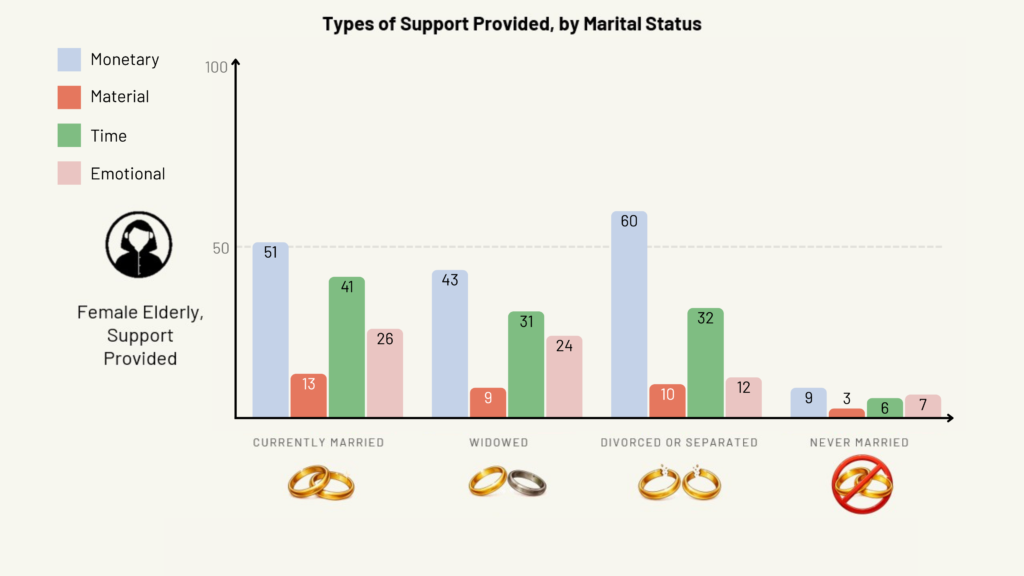
Never-married elderly were the most likely to neither receive nor provide family support of various kinds, with men more likely than women to neither receive nor provide support. This was followed by divorced or separated men.
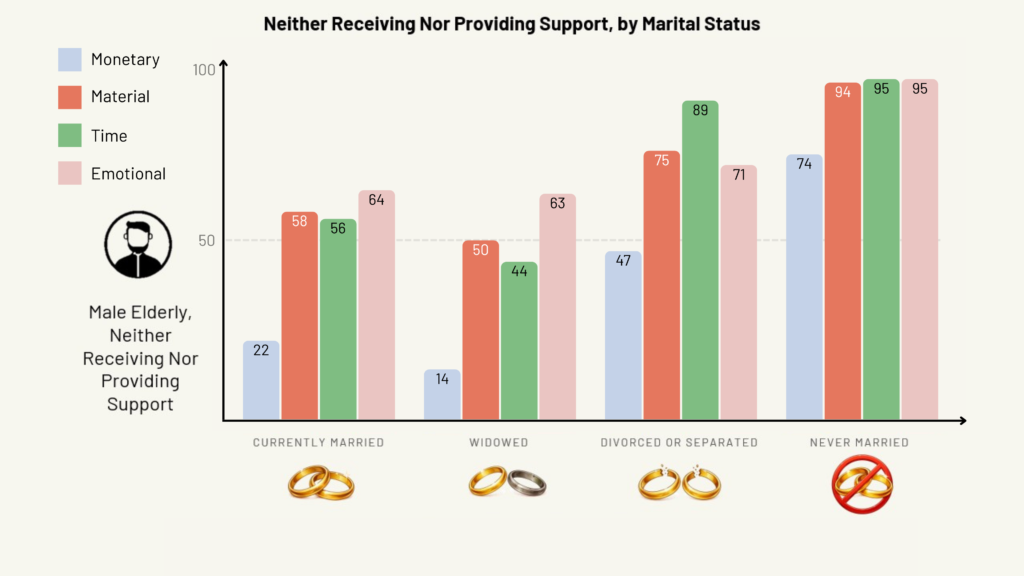
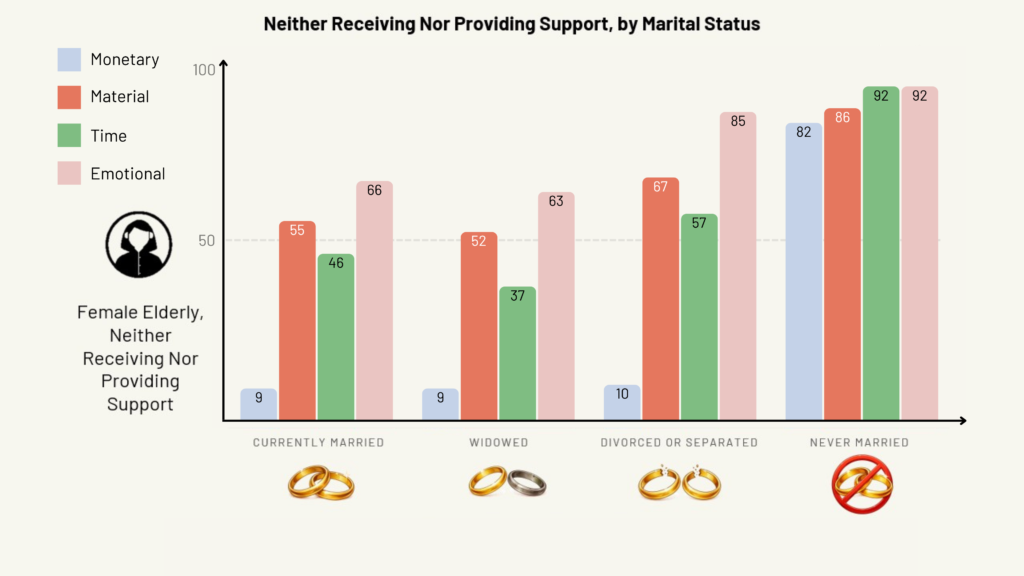
Commenting on those who neither receive nor provide family support, the researchers were unsure whether this raised concerns. On one hand, it could suggest that these elderly “are more independent or have support from other non-familial sources of support” (e.g. domestic helpers or nurses). On the other hand, it may have “a detrimental effect on health and well-being in old age” to neither receive nor provide support, citing other studies on this topic.
Marriage, the Bond that Protects
These findings show the importance of strong marriages – and strong families – in protecting the health and well-being of elderly, with different consequences for those who are married and widowed on one hand, and those never-married or divorced or separated on the other.
Amidst our ageing population, loneliness and social isolation are among the greatest risks faced by the elderly, especially those who are single.
At the same time, reciprocal exchanges of support are a key feature of intergenerational families, as Kalyani K. Mehta and Thang Leng Leng have noted in their study on multigenerational families here. These relationships are based on reciprocal exchanges between the generations, ranging from finances, household chores, food, child-minding, social support and more.
For example, grandparents could take care of the grandchildren when they are young, and the parents (i.e. adult children) would in turn take care of the grandparents in their old age. However, these kinds of exchanges end when the relationship sours.
As the findings confirm, divorce or separation disproportionately affect elderly men, whose relationships with their adult children tend to deteriorate far more than compared to elderly women. These women tend to still have relatively high levels of involvement with their adult children.
On the other hand, elderly widows and widowers consistently receive higher levels of support, likely because relationships remain positive and adult children are aware of their widowed parents’ increased needs for support.
Strengthening Marriage in “Super-aged” Singapore
Even in old age, marriage matters.
And this remains true even as Singapore becomes a “super-aged” society this year, with more than one in five (at least 21%) locals aged 65 years and above. Amidst our demographic trends of low fertility and ageing population, strengthening marriages must be a key priority.
Marriage secures not only the relationship between spouses, but also the relationship between the generations. Strong marriages help to ensure that the needs of the elderly are provided for, even after one spouse passes away.
With a growing number of “grey divorces” (i.e. divorce among older couples), individuals and society need to ensure that their marriages do not grow cold even as they grow old.
At the same time, society should look out for vulnerable seniors, including those who are never married and those whose relationships with their families are weak.
To protect everyone, we – including our laws, policies and culture – must do both: strengthen and encourage marriages, and protect those who are unmarried or affected by marital breakdown.
This also means something for the younger generation and the not-yet seniors. For those who are unmarried, it would help to have a clear-eyed view about the implications of their life choices, should they choose to marry or remain unmarried. For those who are married, it is important for them to continually work on their marriages and ensure their marriages remains strong, even into old age.