Cultivate’s second annual conference, “Unfiltered – The Family on Trial”, delivered a compelling, in-depth look at Singapore’s evolving family ideals, drawing together expert voices, research, and real-life stories at the Lifelong Learning Institute. The central theme was to redefine notions of “success” in Singapore, and how these challenge and reshape the Singaporean family.
Opening Address by Ariel Lim, Cultivate’s Chairperson
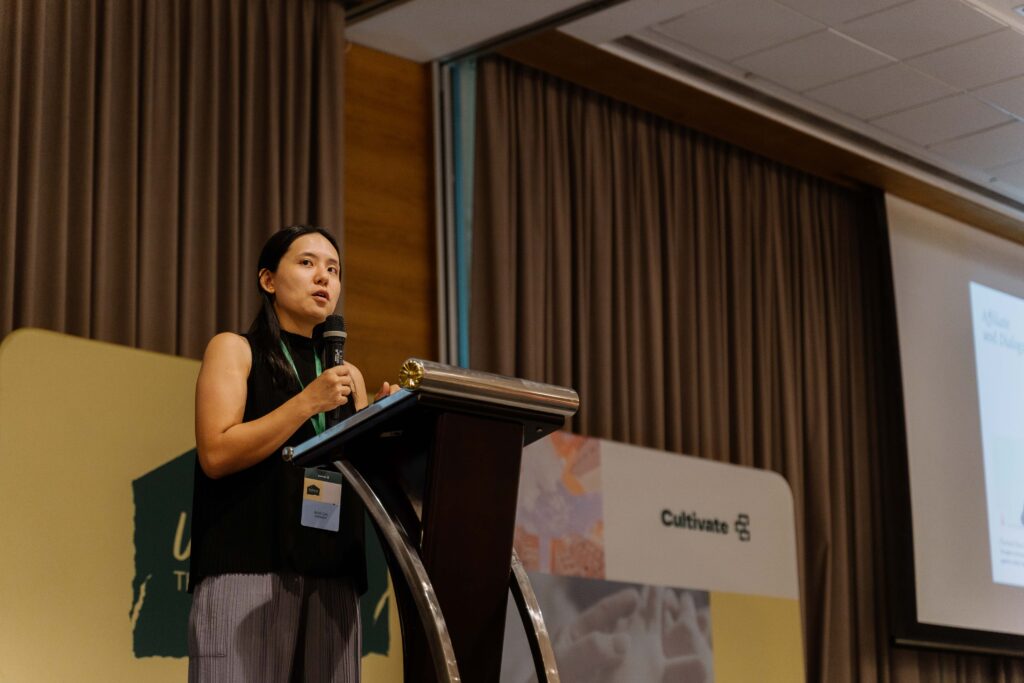
The conference opened with Ariel Lim, chairperson of Cultivate SG, who set the tone by invoking David Foster Wallace’s metaphor about fish unaware of the water they live in. Lim urged participants to consider the invisible social, moral and economic pressures that shape their families daily, asking pointedly what they are cultivating in their lives.
“The most obvious important realities are often the ones that are hardest to see and talk about. Whether it’s the water around fishes or the garden around plants, we at Cultivate are concerned about the moral and the economic and the social environment, the thought patterns, the reigning philosophies of today that surround individuals, that surround families and community.”
Although “boring truths” – such as “how families need stable marriages between a man and a woman for children to grow up well” – have often been repeated when she was growing up, she spoke of how these truths keep her going “every day, sometimes through the hour”.
Thus, she invited the audience to think, “What is something you have already been cultivating and how will you do it?”
A Thoughtful Keynote Address: “Singapore Awakened”
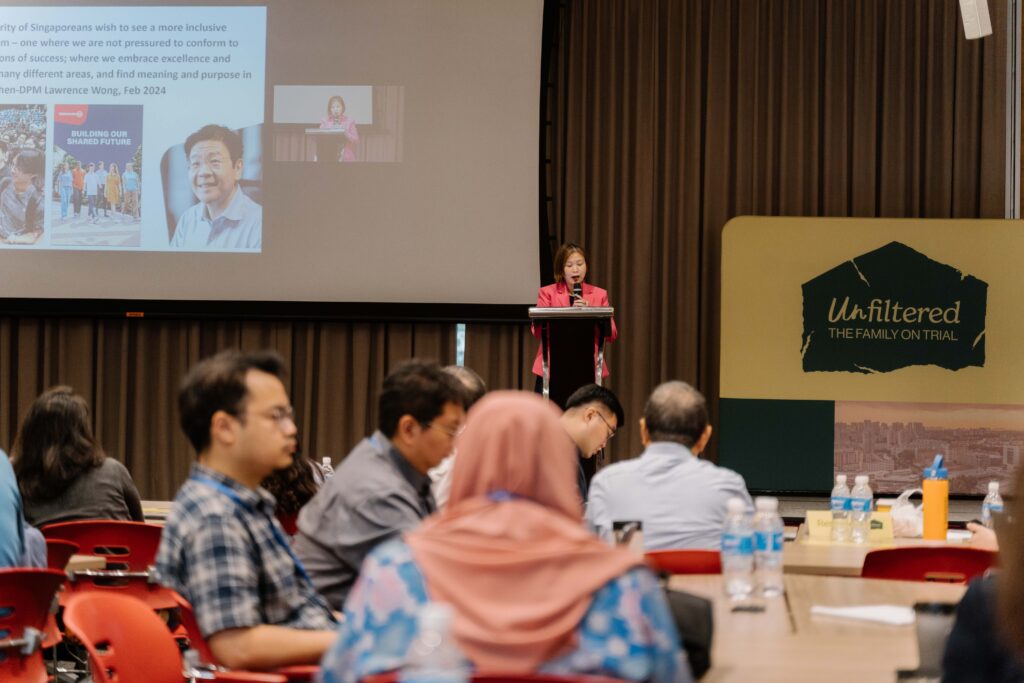
The keynote address by Associate Professor (Dr) Tan Seow Hon, from the Singapore Management University was a standout moment. Titled “Singapore Awakened: How Success – and the Alternative of Flourishing – Shape Family”, she critiqued the nation’s long-standing narrative of material success. This narrative traced its origins to economic challenges amid the historical and geopolitical realities of post-Independence Singapore, which no longer fully serves the country’s citizens today.
She presented a neo-Aristotelian framework of flourishing based on “living an examined life,” encouraging the audience to consider a more holistic vision including life, knowledge, play, reason, spirituality, aesthetics, and friendship as crucial pillars of life. These seven goods, according to John Finnis, differ from other schools of thought on human flourishing, such as the Harvard Flourishing Program that focuses on – as Dr Tan described – “subjective experiences of well-being of a group of persons”.
Dr Tan brought the audience through various policies that prioritised economic pragmatism, such as the decision to allow casinos (known as “integrated resorts”). Education is also increasingly framed as preparation for economic contribution, such as the emphasis on STEM (Science, Technology, Engineering and Math) subjects.
Marriage and family have been negatively affected by the emphasis on material success. Anti-natalist policies – including the two-child policy, liberal abortion and sterilisation, and the “Graduate Mother Scheme” (1984) – conveyed a view of human worth tied to economic contribution rather than intrinsic dignity.
To move towards a more holistic vision, she proposed some attitudinal shifts, including:
- Seeing economic growth as the means, not the end; individual flourishing is the end
- An alternative to success based on eudemonia, a richer and more abundant life of flourishing
“Laws and policies that facilitate flourishing and a narrative that supports flourishing will bring the nation into a sustainable future on a new ethos because it respects individuals for who we truly are,” said Dr Tan.
Marriage, Parenthood and Success Survey: Families Speak Out
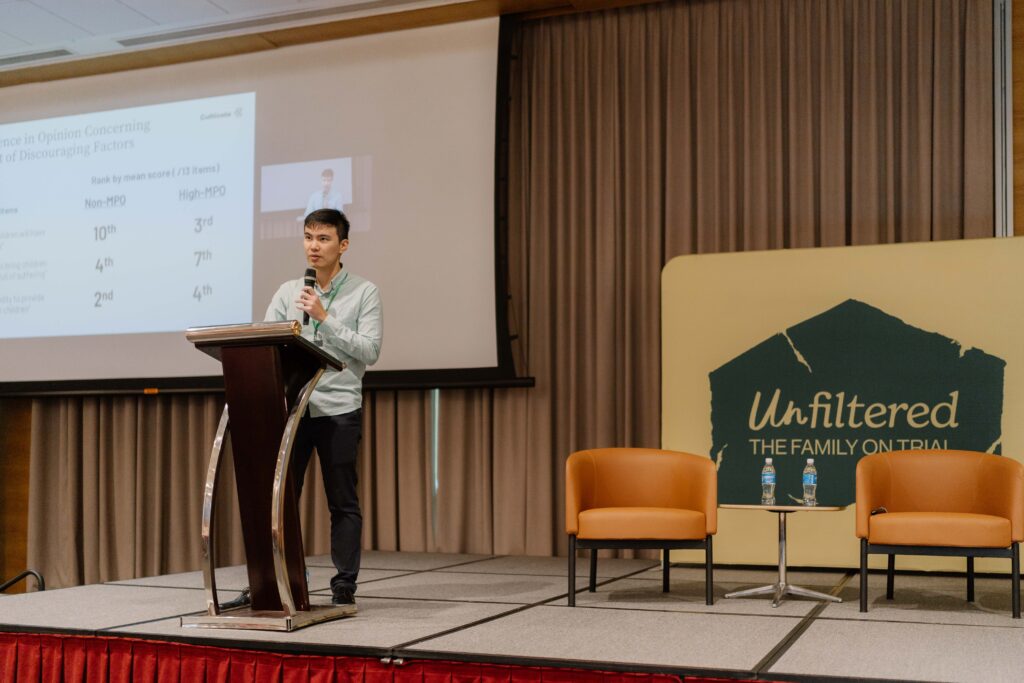
Research and Policy Lead Daniel Lim shared the findings of Cultivate’s latest “Marriage, Parenthood and Success” Survey, covering 2,019 Singapore Citizens and Permanent Residents aged 21 to 45.
Key findings include:
- Those with positive views and aspirations towards marriage and parenthood are less likely to delay marriage
- “Having a child” seen as a more essential element in marriage by those who strongly value marriage and parenthood
- Safety, stability, and parental involvement ranked as top priorities for parents across gender lines.
- Financial considerations are strong factors discouraging parenthood, but those who highly value marriage and parenthood are less impacted
- Half of surveyed women felt they made greater sacrifices in marriage and parenthood, a view far less common among men
- “Being an upright person” is the top marker of success in life on overall, while “being married” and “having children” rank low except to those oriented towards them
Spirited Dialogue on “Success and Family”
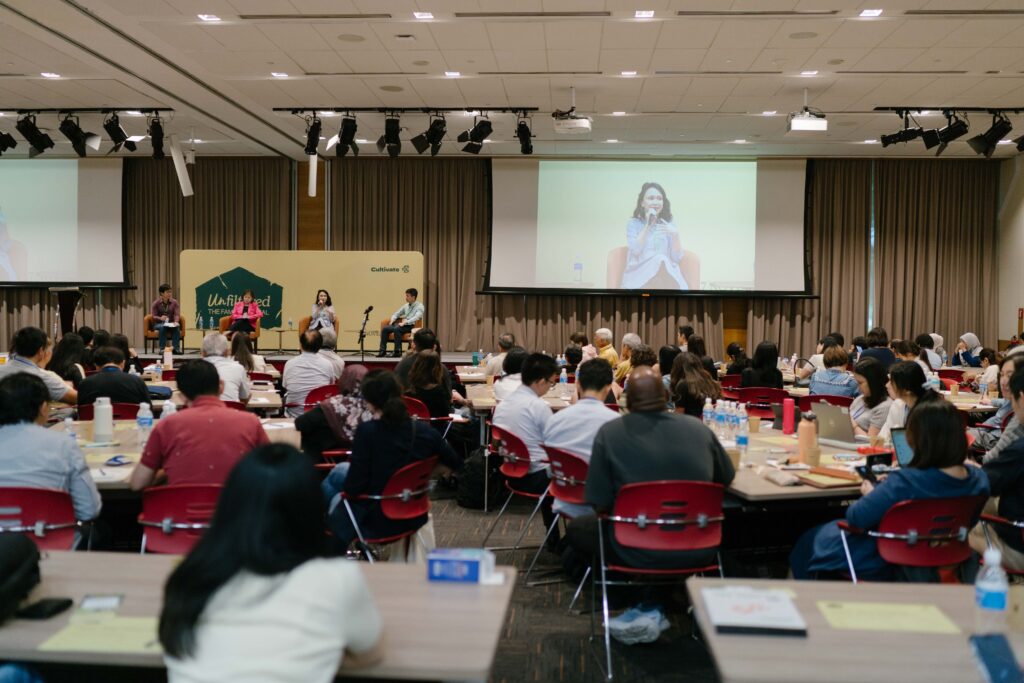
A diverse panel followed, featuring Dr Tan, Daniel Lim and Mums for Life co-founder Fannie Lim, a mother of three. Fannie candidly described her journey from tech sales to stay-at-home mother to leading a charity for low-income families.
She emphasised the need for both mothers and fathers to fully invest in parenting – not just as a 50-50 split of labour, but as a full and authentic commitment to each other and their children. She recounted how Mums for Life was started to complement the Dads for Life movement, helping mothers – often consumed by motherhood – to remember their other identities as woman, daughter, and wife. On the issue of sacrifice, she advocated a shift away from focusing on loss toward recognising the rewards of raising a family.
“It is not even a 50-50 type of partnership,” she added. “It is a 100% partnership, where we become who we are, to the best of our potential, as this woman [and] mother, and then for the men to also become a 100% version of who they’re supposed to be.” Responding to a question on the Singapore Dream, Dr Tan traced her life journey of receiving support through government scholarships, and said that it was a “good dream” because it “allowed us to advance”. However, citing a speech by Minister Chan Chun Sing, she noted that the current iteration of meritocracy leads to socio-economic stratification.
“Thriving Amidst Trial” – Facing Adversity, Seeking Reform
Families are not perfect. Despite our best efforts, marriages and families may still break apart. What does it mean to “succeed” or “thrive” amidst these challenges?
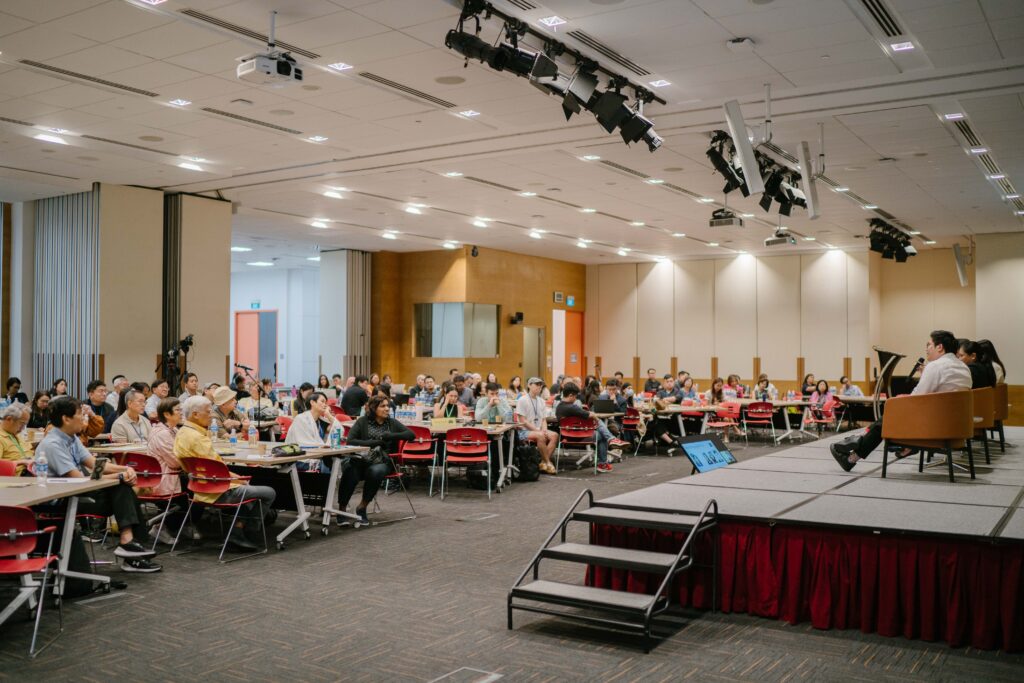
Principal social workers Kristin Lim and Nur Fariza detailed the daily struggles of families who face overwhelming stressors, including systemic and economic barriers. These include isolating fear, less flexible hours, rising costs and limited safety nets. They reframed success not as an absence of hardship but as the ongoing process of adaptation, mutual support, and hope—especially for those disadvantaged from the start.
Law student Emmanuel Wong shared his firsthand account growing up amid divorce during the pandemic, which he recalled was similar to other divorces “except that you can’t move out of the house”. It was a “terrifying reality” of how his parents were fighting, and in the next moment in separate Zoom calls with the judge. His story highlighted the power of intervention and community support, describing how his teachers arranged a temporary move so he could concentrate on his studies and ultimately succeed academically.
He credited his entry into law school to the people who supported him: “It was really by accumulation of so many people’s love, care, investment and belief in me that got me to where I am.” He left three reflections for children living in families on trial: first, we only can succeed when someone can go the extra mile for us; second, to see children in these situations more as persons than as patients; third, the importance of forgiveness.
Proposal to Reform Guardianship Law
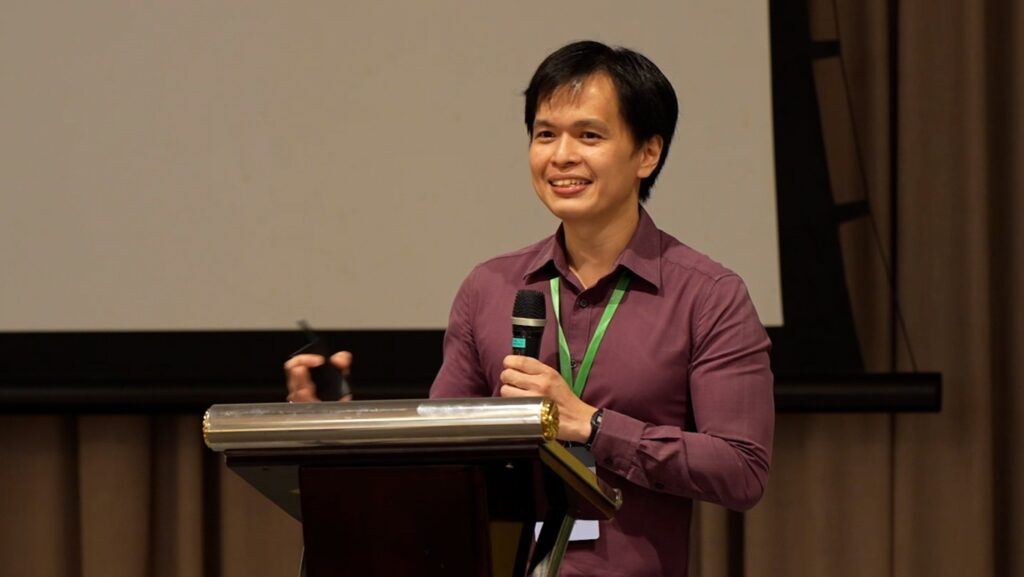
A notable highlight of the conference was the proposal by Cultivate’s executive director Darius Lee to reform Singapore’s guardianship laws. Calling for a statutory regime for non-parental guardianship and greater legal adaptability in cases where parents cannot fulfil their duties, Cultivate’s recommendation responded to legal and judicial calls for reform, anchoring the discussion in children’s welfare.
Currently, Singapore’s laws only allow for the appointment of guardians in three situations:
- When one parent passes away
- By court appointment when a child has “no parent, no guardian of the person and no other person having parental rights with respect to him”
- Wardship jurisdiction, which has been developed by courts through case law to protect children
Darius echoed the calls made by Justice Debbie Ong in two separate cases, to create a “a clearly-defined statutory regime through which non-parents may apply for the necessary orders for the welfare of children”, and to allow “non-parents with some connection to a child” to make applications for orders in respect of children.
He further called for reforms of the Guardianship of Infants Act to allow a parent to nominate a guardian in the event the parent loses capacity and there is no one else able to discharge parental / guardianship responsibilities, and to also allow a court to appoint a guardian when no one is able and willing to discharge these responsibilities over a child.
“Fundamentally, what we’re really concerned about is the welfare of children,” Darius remarked.
“Trampoline and Stairs” – Reflection and Vision
The conference ended on evocative imagery, as Darius left audiences to reflect on the images of both trampoline and stairs.
Citing a performance by Yoann Bourgeois, he said that this was a picture of a climb towards success. A person climbs, but falls and bounces back up. Eventually, he reaches the top.
“So ultimately what we aim for at the top will shape what we tell ourselves and our children to aspire towards, what we are prepared to sacrifice to get to the top… And it also shapes the kind of people that we look up to, and the people that we do not.”
As for the “trampoline”, Darius cited the words of then-Deputy Prime Minister and Finance Minister Tharman Shanmugaratnam, who famously responded “I believe in the notion of a trampoline” when asked if he believed in social safety nets.
Yet, there was a “hard truth” that some people are unable or even unwilling to bounce back from adversity.
He urged participants not only to seek individual growth and achievement but to cultivate mutual support and resilience, reinforcing that the family remains the primary site of society’s foundation. It is “the first arena” and “the first society” in which we have to practise interdependence.
With expert insights, original research findings, personal narratives, and policy ideas, “Unfiltered – The Family on Trial” 2025 left its mark as a forum of not just discussion, but action and empathy for the families of Singapore.
Watch the videos from “Unfiltered – The Family on Trial” on YouTube here.